WEEK
2 NEWS - beautiful spring
days to welcome us back to Greece: magnificent deserted wild beaches, Independence Day
celebrations in Gastouni, a total solar eclipse at Ancient Olympia, and
the Temple of Bassae high in the Messinian mountains:
You would be
hard put to find a more delightful place this side of heaven than
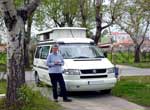
Camping Aginara Beach in early Spring: the air is refreshingly warm, the
silence is deafening, apart from the ever-present birdsong, and the sound of surf crashing onto the beach is mystical. And on a sunny morning,
the view from under the trees which fringe the beach, across to the
island of Zakynthos silhouetted on the misty horizon, is unforgettable.
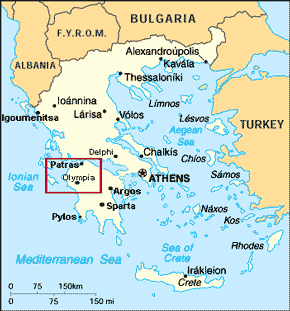
Click on highlighted area
for details of
Achaia and Ellis
It is so good to be back, especially for the sunsets across the Ionian
Sea
(Photo 1). On our first night in
Greece, still bemused after
the traffic mayhem of Patras port, we found
sanctuary in the delightful gardens of Camping Rion, close to the
ferries which still ply across the Gulf of Corinth, and now
overshadowed by the new and elegant Rion Bridge. Next morning, a 100 kms
drive through pouring rain brought us round the NW Peloponnesian coast
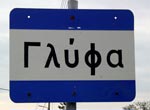
to recuperate for a few days at Aginara Beach near to the village of
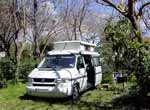
Glypha (see left). And as if to welcome us, Spring weather brought a revitalising
warmth to the air (Photos 2 & 3).
March 25 is
Greek Independence Day;
our reason for coming out early was to share in
the celebrations of the day traditionally marked as the date in
1821 when Germanos, Patriarch
of Patras, raised the banner of revolt against 400 years of barbaric
Turkish rule, leading to Greece's reassertion as an
independent state
(see right).
Every town and village has its parade to mark this important
anniversary, with youngsters in national costume, the boys dressed like
young evzones guards with white kilts and pom-pom shoes. We joined local
people in the nearby small town of Gastouni for the Independence Day
Mass and Procession, led by the town band, along to the wreath-laying
ceremony at the war memorial. With Greece's tragic history during the
20th century, there is no shortage of war-dead to be remembered. We felt
honoured to share in this colourful and moving ceremony (Photo 4).
Just how many highlights
can you cram into one busy week? We moved on to Ancient Olympia to see
the treasures at the Archaeological Museum, to witness March 29's solar
eclipse, where else but at the Temple of Zeus at Olympia, and as a
climax to the week, to visit the Temple of Apollo at Bassae in the mountains.
The modern town of Olympia
is not an attractive place, the main street lined with emporia selling
schmuck to the 1000s who flock here daily in armadas of tour-buses. Just
above the town is Camping Diana, kept by a hospitable retired academic who chats away to us in French.
It must be the only campsite-reception with the works of Plato,
Demosthenes and Herodotus on the bookshelves. We had set aside 2 days
here to revisit the Archaeological Museum and to witness the total solar
eclipse at the Sanctuary of Olympian Zeus, which seemed somehow the appropriate place for this.
And as if a good omen, all around the grassy banks were carpeted with
scarlet and lavender-coloured wild anemones.
The Olympia Archaeological
Museum displays all the finds from the nearby Sanctuary site. Much of
the military hardware,
religious
artefacts and sculptures now displayed were dedicated to Zeus at Olympia
by ancient Greek city-states, commemorating victories in war or successes
in the Games to
boost their political prestige, making this one the finest collections
of archaeological treasures outside Athens. 2 such dedicatory offerings
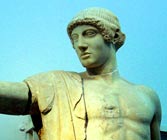
preserved in the Museum are the helmet worm by the Athenian general Miltiades in defeating the invading Persians at the Battle of Marathon in 490 BC (see left), and the
elegant 330 BC statue of Hermes with the
infant Dionysus, sculpted by Praxiteles (Photo 5) and preserved
virtually intact. We were
fortunate in having one of the few quiet days for our visit, enabling us
to study and to photograph the beautiful exhibits largely in undisturbed
peace. It was another day of happy recollections.
SOLAR ECLIPSE: View
details of EclipseThe central line of totality
for the solar eclipse of 29 March 2006 passed from North Africa, across
the Aegean between Crete and Cyprus, and on over southern Turkey.
Although some 200 miles from this line in NW Peloponnese, we hoped we
should experience almost full totality.
All we needed was clear weather. We had chosen to witness the
phenomenon at the Sanctuary of Zeus at
Olympia, home of the ancient Olympic Games established here in
776 BC and originally part of the religious
festival. The centrepiece of the Sanctuary are
the remains of the Temple of Olympian Zeus, built in the 5th century
BC to house the monumental gold
and ivory cult-statue of the god, one of the 12 wonders of the
ancient world. The temple stood for almost 1000 years, and the collapsed
Doric columns which once surrounded
the temple
now lie strewn across the ground from when an earthquake destroyed
the structure in the 5th
century AD. The mighty foundation base of the temple still stands,
and it was at this spot that we chose to
observe the
2006 eclipse (Photo 6). Viewed through dark eclipse-viewing
glasses, the moon began
its transit across the sun's surface at around
12-40 pm Greek time, and took an hour to achieve the maximum
level of
cover, leaving just a crescent
sliver of remaining sunlight (see right).
Even with this degree of penumbral shadow, such was the sun's power that
normal daylight was only marginally reduced to a sort of evening dusk
with slightly increased cool wind. And tourists wandered by, oblivious
of the Titanic happening taking place. Athens News, the weekly
English-language Greek newspaper, reported that those observing on the
tiny Greek island of Kastellorizo just off the Turkish coast witnessed a
period of totality lasting 4 minutes; normal daylight was cast into
gloom and the birds fell silent. At Olympia, the spectral dusk confused
local cocks who began crowing. As the moon passed across the sun's
face and normal daylight resumed, we continued our exploration of
Olympia's archaeological site, revisiting the Stadium where the ancient
Games were held and the other partly restored monuments (Photo 7). Memories of this day's happening, witnessed in this setting, will last a
life-time.
Leaving Olympia, we headed
up into the mountains to the small town of Andritsena, perched
precariously on the steep mountain-side, where we had promised ourselves
a soublaki lunch at a tiny taberna in the narrow main street visited in
2004. This simple meal was yet another highlight of the trip. You need to experience Greek
hospitality and values to appreciate
fully just how much of civilised life we have lost in UK's mercenary society.
Our reason for venturing high into the mountains was to revisit the 5th
century BC Temple of Apollo
Epikourios ('Helper') at Bassae. Pausanias, the 2nd century AD travel
writer reports that the Phigaleians built the temple as a thanksgiving
to Apollo, their protecting deity, for sparing them from the plague.
Despite being poor mountain farming folk, the Phigaleians commissioned
the top architect of the day, Ictinos from Athens who had built the
Parthenon, to design their votive offering to Apollo. The remote location was
a cult-site, high on a shoulder-plateau of Mount Kotilion at 3,700 feet.
Amazingly, after 2,500 years of ravaging by weather and earthquakes,
the Classical temple at Bassae remains one of the best-preserved in
Greece. Despite now being swathed in a protective canopy (see left) as part
of the conservation programme, it is a startlingly impressive sight (Photo
8). To see the temple in the bright morning light, we wild-camped
nearby at 3,500 feet. Our reward was to experience an awesomely bright
dawn as the sun flared out above the mountainous eastern horizon at 7-15
am; it was as if Apollo himself was welcoming us to his remote retreat in the
mountains.
From Bassae, we wound our way down the narrow mountain road, past the
modern village of Phigaleia, back to the coast at Tholo - but that's a
story for another week. So stay tuned ...
Sheila
and Paul Published: Sunday 2 April
2006
Next edition to be published in 2 weeks


 It is so good to be back, especially for the sunsets across the Ionian
Sea
(Photo 1). On our first night in
Greece, still bemused after
the traffic mayhem of Patras port, we found
sanctuary in the delightful gardens of Camping Rion, close to the
ferries which still ply across the Gulf of Corinth, and now
overshadowed by the new and elegant Rion Bridge. Next morning, a 100 kms
drive through pouring rain brought us round the NW Peloponnesian coast
to recuperate for a few days at Aginara Beach near to the village of
Glypha (see left). And as if to welcome us, Spring weather brought a revitalising
warmth to the air (Photos 2 & 3).
It is so good to be back, especially for the sunsets across the Ionian
Sea
(Photo 1). On our first night in
Greece, still bemused after
the traffic mayhem of Patras port, we found
sanctuary in the delightful gardens of Camping Rion, close to the
ferries which still ply across the Gulf of Corinth, and now
overshadowed by the new and elegant Rion Bridge. Next morning, a 100 kms
drive through pouring rain brought us round the NW Peloponnesian coast
to recuperate for a few days at Aginara Beach near to the village of
Glypha (see left). And as if to welcome us, Spring weather brought a revitalising
warmth to the air (Photos 2 & 3).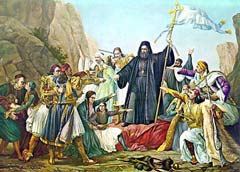 independent state
(see right).
Every town and village has its parade to mark this important
anniversary, with youngsters in national costume, the boys dressed like
young evzones guards with white kilts and pom-pom shoes. We joined local
people in the nearby small town of Gastouni for the Independence Day
Mass and Procession, led by the town band, along to the wreath-laying
ceremony at the war memorial. With Greece's tragic history during the
20th century, there is no shortage of war-dead to be remembered. We felt
honoured to share in this colourful and moving ceremony (Photo 4).
independent state
(see right).
Every town and village has its parade to mark this important
anniversary, with youngsters in national costume, the boys dressed like
young evzones guards with white kilts and pom-pom shoes. We joined local
people in the nearby small town of Gastouni for the Independence Day
Mass and Procession, led by the town band, along to the wreath-laying
ceremony at the war memorial. With Greece's tragic history during the
20th century, there is no shortage of war-dead to be remembered. We felt
honoured to share in this colourful and moving ceremony (Photo 4).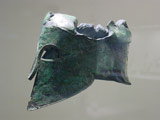 The Olympia Archaeological
Museum displays all the finds from the nearby Sanctuary site. Much of
the military hardware,
religious
artefacts and sculptures now displayed were dedicated to Zeus at Olympia
by ancient Greek city-states, commemorating victories in war or successes
in the Games to
boost their political prestige, making this one the finest collections
of archaeological treasures outside Athens. 2 such dedicatory offerings
preserved in the Museum are the helmet worm by the Athenian general Miltiades in defeating the invading Persians at the Battle of Marathon in 490 BC (see left), and the
elegant 330 BC statue of Hermes with the
infant Dionysus, sculpted by Praxiteles (Photo 5) and preserved
virtually intact. We were
fortunate in having one of the few quiet days for our visit, enabling us
to study and to photograph the beautiful exhibits largely in undisturbed
peace. It was another day of happy recollections.
The Olympia Archaeological
Museum displays all the finds from the nearby Sanctuary site. Much of
the military hardware,
religious
artefacts and sculptures now displayed were dedicated to Zeus at Olympia
by ancient Greek city-states, commemorating victories in war or successes
in the Games to
boost their political prestige, making this one the finest collections
of archaeological treasures outside Athens. 2 such dedicatory offerings
preserved in the Museum are the helmet worm by the Athenian general Miltiades in defeating the invading Persians at the Battle of Marathon in 490 BC (see left), and the
elegant 330 BC statue of Hermes with the
infant Dionysus, sculpted by Praxiteles (Photo 5) and preserved
virtually intact. We were
fortunate in having one of the few quiet days for our visit, enabling us
to study and to photograph the beautiful exhibits largely in undisturbed
peace. It was another day of happy recollections.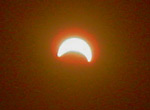 around
12-40 pm Greek time, and took an hour to achieve the maximum
level of
cover, leaving just a crescent
sliver of remaining sunlight (see right).
Even with this degree of penumbral shadow, such was the sun's power that
normal daylight was only marginally reduced to a sort of evening dusk
with slightly increased cool wind. And tourists wandered by, oblivious
of the Titanic happening taking place. Athens News, the weekly
English-language Greek newspaper, reported that those observing on the
tiny Greek island of Kastellorizo just off the Turkish coast witnessed a
period of totality lasting 4 minutes; normal daylight was cast into
gloom and the birds fell silent. At Olympia, the spectral dusk confused
local cocks who began crowing. As the moon passed across the sun's
face and normal daylight resumed, we continued our exploration of
Olympia's archaeological site, revisiting the Stadium where the ancient
Games were held and the other partly restored monuments (Photo 7). Memories of this day's happening, witnessed in this setting, will last a
life-time.
around
12-40 pm Greek time, and took an hour to achieve the maximum
level of
cover, leaving just a crescent
sliver of remaining sunlight (see right).
Even with this degree of penumbral shadow, such was the sun's power that
normal daylight was only marginally reduced to a sort of evening dusk
with slightly increased cool wind. And tourists wandered by, oblivious
of the Titanic happening taking place. Athens News, the weekly
English-language Greek newspaper, reported that those observing on the
tiny Greek island of Kastellorizo just off the Turkish coast witnessed a
period of totality lasting 4 minutes; normal daylight was cast into
gloom and the birds fell silent. At Olympia, the spectral dusk confused
local cocks who began crowing. As the moon passed across the sun's
face and normal daylight resumed, we continued our exploration of
Olympia's archaeological site, revisiting the Stadium where the ancient
Games were held and the other partly restored monuments (Photo 7). Memories of this day's happening, witnessed in this setting, will last a
life-time.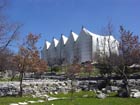 Leaving Olympia, we headed
up into the mountains to the small town of Andritsena, perched
precariously on the steep mountain-side, where we had promised ourselves
a soublaki lunch at a tiny taberna in the narrow main street visited in
2004. This simple meal was yet another highlight of the trip. You need to experience Greek
hospitality and values to appreciate
fully just how much of civilised life we have lost in UK's mercenary society.
Our reason for venturing high into the mountains was to revisit the 5th
century BC Temple of Apollo
Epikourios ('Helper') at Bassae. Pausanias, the 2nd century AD travel
writer reports that the Phigaleians built the temple as a thanksgiving
to Apollo, their protecting deity, for sparing them from the plague.
Despite being poor mountain farming folk, the Phigaleians commissioned
the top architect of the day, Ictinos from Athens who had built the
Parthenon, to design their votive offering to Apollo. The remote location was
a cult-site, high on a shoulder-plateau of Mount Kotilion at 3,700 feet.
Amazingly, after 2,500 years of ravaging by weather and earthquakes,
the Classical temple at Bassae remains one of the best-preserved in
Greece. Despite now being swathed in a protective canopy (see left) as part
of the conservation programme, it is a startlingly impressive sight (Photo
8). To see the temple in the bright morning light, we wild-camped
nearby at 3,500 feet. Our reward was to experience an awesomely bright
dawn as the sun flared out above the mountainous eastern horizon at 7-15
am; it was as if Apollo himself was welcoming us to his remote retreat in the
mountains.
Leaving Olympia, we headed
up into the mountains to the small town of Andritsena, perched
precariously on the steep mountain-side, where we had promised ourselves
a soublaki lunch at a tiny taberna in the narrow main street visited in
2004. This simple meal was yet another highlight of the trip. You need to experience Greek
hospitality and values to appreciate
fully just how much of civilised life we have lost in UK's mercenary society.
Our reason for venturing high into the mountains was to revisit the 5th
century BC Temple of Apollo
Epikourios ('Helper') at Bassae. Pausanias, the 2nd century AD travel
writer reports that the Phigaleians built the temple as a thanksgiving
to Apollo, their protecting deity, for sparing them from the plague.
Despite being poor mountain farming folk, the Phigaleians commissioned
the top architect of the day, Ictinos from Athens who had built the
Parthenon, to design their votive offering to Apollo. The remote location was
a cult-site, high on a shoulder-plateau of Mount Kotilion at 3,700 feet.
Amazingly, after 2,500 years of ravaging by weather and earthquakes,
the Classical temple at Bassae remains one of the best-preserved in
Greece. Despite now being swathed in a protective canopy (see left) as part
of the conservation programme, it is a startlingly impressive sight (Photo
8). To see the temple in the bright morning light, we wild-camped
nearby at 3,500 feet. Our reward was to experience an awesomely bright
dawn as the sun flared out above the mountainous eastern horizon at 7-15
am; it was as if Apollo himself was welcoming us to his remote retreat in the
mountains.