WEEKS
3~4 NEWS - the Southern Peloponnese: Navarino Bay
at sandy Pylos, Ancient Messene, Kardamyli and The Mani, Monemvasia,
and finally Sparta and Mystras
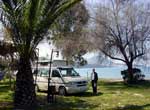
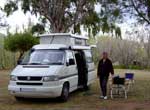
Our camp at
Navarino Bay overlooked the site of the naval encounter in 1827, when a
small European squadron destroyed a massive Turkish fleet, so ensuring
Greek victory in the War of Independence. But at this time of year it was
idyllically
peaceful; from under the trees that fringed the
beach, we looked out across the still waters, enclosed on the seaward
side by the length of Sphacteria island, with the town of Pylos nestled
into the hills to the south.
Click on highlighted area
for details of
Southern Peloponnese
The sweet scent of orange blossom wafted over our
camp from the trees growing behind us, with the tiny swelling of next
year's fruit forming in the centre of the waxy white flowers (Photo 1).
We had begun
this week's journey south down the Peloponnesian coast from Tholo, where
the campsite owner had declared that, since he was not open, he
would not accept any payment, but we were welcome to stay anyway; and
further to underline his hospitality, he picked us oranges from his
orchard. Saturday morning shopping in busy Kyparissia
was a pleasant necessity, and from this week's Athens News, we
learnt a Greek saying quite relevant to our busy programme:
Τρεχω
και δεν φτανω - I run, but am not arriving (so much to do, and little
time to do it all). Continuing south, we got our first glimpse of
Navarino Bay spread out along the horizon. Our camp in this wonderful
setting, with the morning sun lighting the limestone cliffs of
Sphacteria island and the waves gently lapping the beach, was
unsurpassed. And that evening, we were rewarded with a sunset
performance like no other (Photo 2), trailing a golden tail
across the Bay, and an afterglow casting a darkening pink aura across
the western sky.
The glorious
Spring weather continued for our day's walking over to Voidokilia Bay.
By the Lagoon trapped behind the northern headland, egrets and grey
heron fished under wispy tamarisk trees in full blossom. From the
narrow sea channel separating
Sphacteria island, the path sloped upwards through juniper groves and a
colourful paradise of wild flowers, towards the remains of the Frankish
fortress of Paliokastro which crowns the headland. From the overgrown
ruins, we could look down over the craggy cliffs to Voidokilia Bay 400
feet below. The name means 'Ox belly' which perfectly describes its
circular outline. The shallow waters glowed turquoise in the clear light
(Photo 3), backed by the distant mountainous skyline. A
challenging path down the northern precipice led to the dunes
enclosing Voidokilia, and along the Lagoon behind the Bay we enjoyed
further rewarding birdlife sightings.
We had to
revisit the magnificently preserved Mycenaean Palace of Nestor, which
had formed the power-base of an extensive kingdom in the late 2nd
millennium BC, ruled over by the garrulous King of Sandy Pylos as
described in Homer's Odyssey. To say such archaeological sites are
'managed' by the Greek Ministry of Culture would be a misnomer, and
unhelpful attendants regard visitors with bored indifference. Even so,
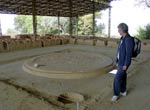
there was that feeling of awe as we approached the Palace's entrance
court, with its stone bases of the columns which had supported the upper
storey. The centrepiece is the Throne Room with its huge ceremonial
hearth where official visitors were received. And at a more personal
level, the excavations revealed a bathroom exactly as described by
Homer, with terracotta bathtub decorated with painted scrolled patterns.
The Palace complex was destroyed by unknown invaders around 1200 BC like
the other Mycenaean citadels, but an amazing wealth of excavated finds
are displayed in the local museum in the nearby town of Chora, including
elegant pottery, magnificent gold cups and jewellery and clay tablets
inscribed with Palace archives in Linear B script, an early form of
Greek. But most of all, the wonderfully preserved fragments of frescoes
which decorated the walls and floors of the complex enlivened one's imagination of Palace life.
We moved
on for a brief stay at the delightful family-run Thines Camping at
Finikounda, where we had arranged to meet with Barry and Margaret
Williamson. And what a privilege it was to share conversation with such
like-minded travellers, whose world-wide ventures and long-distance
cycling journeys are so impressive. Do be sure to visit their
website on www.magbaztravels.com for so many fascinating details of their journeys.
Our journey
now took us back into the mountains of inland Messinia, to wild camp by
the walls of Ancient Messene, refortified in 371 by the Messinians newly
released from serfdom after the defeat of Sparta by the Thebans. In the
late afternoon sunshine, we took a turn of sentry duty along the best
preserved section of fortification walls over the steep hillside. Our camp at
2,500 feet was blessed with a crystal clear night with just the lights
of nearby Mavromati village twinkling across the hillside. The following
day, in a fiercesomely gusting SW gale, we climbed Ithome the sacred
mountain of the Messinians, topped now by the ruins of a Byzantine
monastery, looking down over the Messene archaeological site.
To reach the
barren wilds of the Mani peninsula meant driving through Kalamata, a
notoriously unattractive city, still marred by the aftermath of the 1986
earthquake, and having in our view the most homicidal driving standards
in Greece. But over the mountains, we descended to one of our favourite
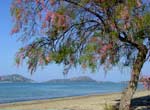
Greek villages, Kardamyli, to camp among olive groves (Photo 4)at the delightfully straightforward Ta Delphinia (Dolphins) Camping.
Ioannis the owner recalled our previous visit and welcomed us with
characteristic Greek hospitality. The southern Mani has an idiosyncratic
culture and history to match its wild and barren landscape. Some have
suggested
that the Maniots were descendents of the Spartans, and their
warlike social system based around clan-loyalties supports this. With so
little fertile land to support a sizeable population, piracy and
brigandage
became a way of life. Inter-clan blood feuds and vendettas lasted for
years, and the only law was that of the gun. Clans occupied tower-house
complexes, easier to defend against the cannons of neighbours, and many
such Maniot towers survive, either in ruins as at hilltop Vatheia (Photo
5) or tarted up as tourist hotels or 2nd homes for Kalamatans.
Despite this lawless history, the first shots of the War of Independence
against the Turks in 1821 were fired by Maniots, led by Petrobey Mavromichalis,
whose fearsomely moustachioed statue still dominates the square in
Areopoli. The Mani peninsula terminates at Cape Tenaro, and there we
wild-camped in a bleak and wind-swept spot, the southernmost point of
mainland Greece. From here it would be north all the way.
An
overnight stop at Gythion enabled us to catch up on functional chores
like clothes washing, but the only worthwhile feature of this campsite
was the view from the showers of swallows, newly returned from African
migration, building nests on the light-fitting. Our appointment next day
however was with the Nautilia taberna by the port for our lunch of
grilled octopus; if you've never tried it - you are missing out on one
of life's luxuries (Photo 6).
To
complete our circuit of the Southern Peloponnese, we crossed the orange
orchards of the Evrotas delta to the east coast for a short stay at the
aptly-named Paradise camping
near to the spectacular geological phenomenon of Monemvasia's 1,000 feet
high offshore rock bastion. It was fortified during the Byzantine Empire
and is now a fascinating site to explore amid ruins overgrown with giant
fennel. It was a peaceful camp with just the sound of surf washing
onto the shore below us and the sun streaming through the scented
eucalyptus trees. The journey over the Varika peninsula mountains was
spectacular, as
were the views across the blue waters of the Lakonian Gulf and the misty
outline of the Mani on the distant westerly horizon.
And so up
to Sparta to revisit old friends Georgios and Elizabeth at Castle View
Camping near Mystras. It had been a hard winter for them, with floods
from the Taigetos mountains causing much damage; but they welcomed us again
with oranges from their orchard. The Greek people have many paradoxical
ways (and why not - they invented the word), but their open-hearted
hospitality is humbling. Ancient Sparta, with its ruthless militaristic
constitution and economy dependent on serfdom of the Messinian Helots,
triumphed over Athens in the 5th century BC Peloponnesian War, but by
the early Christian era, was no more than a community of farming
villages in the broad Evrotas valley. The Franks had in 1250 AD
fortified the nearby 2000 feet precipitous hill of Mystras; as times
became more unsettled, the inhabitants from the valley sought safety around
the fortress and the town of Mystras grew up. The city flourished to
become a wealthy trading centre and seat of learning and the arts during
the final years of the Greek-Byzantine Empire under the Palaiologoi
emperors. Mystras survived only a few more years after the fall of
Constantinople to the Ottoman Turks in 1454. The scholars of Mystras
fled west, taking with them their knowledge and learning of Classical
Greek literature and philosophy, sowing the seeds of the Renaissance which
so changed the culture of Western civilisation, but left the Greeks to
languish under 350 years of Muslim barbarism. With Independence in 1831,
the modern town of Sparta was refounded, using as building material
stone blocks from Mystras which had originally been plundered from
Classical Sparta. Across 2000 years, the stones had come full circle.
Our camp looked straight up to Mystras, the hill
still topped by the Frankish fortifications and the overgrown ruins of
the medieval city spread across the lower slopes. We spent a wonderful
day exploring the monasteries of Byzantine Mystras with their superbly
preserved frescoes, and the impressive aristocratic mansions. And the
following day, we caught the bus into modern Sparta, one of our favourite
Greek towns, whose citizens are welcoming to visitors, so unlike their
dour Classical predecessors. If you visit Sparta, we thoroughly
recommend the Museum of the Olive and Greek Olive Oil, with its
impressively informative displays on the history and cultivation (almost
unchanged since Mycenaean times as described on the Pylos Linear B
tablets)
of the olive and the significance of olive oil for the modern
Greek economy.
It is now
Holy Week, leading up to Easter, the most important festival in the Greek
Orthodox calendar, when Greeks return home to spend the holiday
with family. We shall now be heading up to the Argolid to spend Easter
with the Darsinos family at Mikines Camping, in Mycenae village. Join us
again next week to share in the traditional Greek Easter celebrations.


 We had to
revisit the magnificently preserved Mycenaean Palace of Nestor, which
had formed the power-base of an extensive kingdom in the late 2nd
millennium BC, ruled over by the garrulous King of Sandy Pylos as
described in Homer's Odyssey. To say such archaeological sites are
'managed' by the Greek Ministry of Culture would be a misnomer, and
unhelpful attendants regard visitors with bored indifference. Even so,
there
We had to
revisit the magnificently preserved Mycenaean Palace of Nestor, which
had formed the power-base of an extensive kingdom in the late 2nd
millennium BC, ruled over by the garrulous King of Sandy Pylos as
described in Homer's Odyssey. To say such archaeological sites are
'managed' by the Greek Ministry of Culture would be a misnomer, and
unhelpful attendants regard visitors with bored indifference. Even so,
there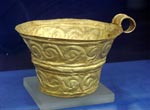 was that feeling of awe as we approached the Palace's entrance
court, with its stone bases of the columns which had supported the upper
storey. The centrepiece is the Throne Room with its huge ceremonial
hearth where official visitors were received. And at a more personal
level, the excavations revealed a bathroom exactly as described by
Homer, with terracotta bathtub decorated with painted scrolled patterns.
The Palace complex was destroyed by unknown invaders around 1200 BC like
the other Mycenaean citadels, but an amazing wealth of excavated finds
are displayed in the local museum in the nearby town of Chora, including
elegant pottery, magnificent gold cups and jewellery and clay tablets
inscribed with Palace archives in Linear B script, an early form of
Greek. But most of all, the wonderfully preserved fragments of frescoes
which decorated the walls and floors of the complex enlivened one's imagination of Palace life.
was that feeling of awe as we approached the Palace's entrance
court, with its stone bases of the columns which had supported the upper
storey. The centrepiece is the Throne Room with its huge ceremonial
hearth where official visitors were received. And at a more personal
level, the excavations revealed a bathroom exactly as described by
Homer, with terracotta bathtub decorated with painted scrolled patterns.
The Palace complex was destroyed by unknown invaders around 1200 BC like
the other Mycenaean citadels, but an amazing wealth of excavated finds
are displayed in the local museum in the nearby town of Chora, including
elegant pottery, magnificent gold cups and jewellery and clay tablets
inscribed with Palace archives in Linear B script, an early form of
Greek. But most of all, the wonderfully preserved fragments of frescoes
which decorated the walls and floors of the complex enlivened one's imagination of Palace life.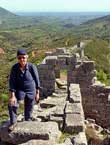 Our journey
now took us back into the mountains of inland Messinia, to wild camp by
the walls of Ancient Messene, refortified in 371 by the Messinians newly
released from serfdom after the defeat of Sparta by the Thebans. In the
late afternoon sunshine, we took a turn of sentry duty along the best
preserved section of fortification walls over the steep hillside. Our camp at
2,500 feet was blessed with a crystal clear night with just the lights
of nearby Mavromati village twinkling across the hillside. The following
day, in a fiercesomely gusting SW gale, we climbed Ithome the sacred
mountain of the Messinians, topped now by the ruins of a Byzantine
monastery, looking down over the Messene archaeological site.
Our journey
now took us back into the mountains of inland Messinia, to wild camp by
the walls of Ancient Messene, refortified in 371 by the Messinians newly
released from serfdom after the defeat of Sparta by the Thebans. In the
late afternoon sunshine, we took a turn of sentry duty along the best
preserved section of fortification walls over the steep hillside. Our camp at
2,500 feet was blessed with a crystal clear night with just the lights
of nearby Mavromati village twinkling across the hillside. The following
day, in a fiercesomely gusting SW gale, we climbed Ithome the sacred
mountain of the Messinians, topped now by the ruins of a Byzantine
monastery, looking down over the Messene archaeological site.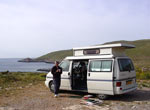 that the Maniots were descendents of the Spartans, and their
warlike social system based around clan-loyalties supports this. With so
little fertile land to support a sizeable population, piracy and
brigandage
became a way of life. Inter-clan blood feuds and vendettas lasted for
years, and the only law was that of the gun. Clans occupied tower-house
complexes, easier to defend against the cannons of neighbours, and many
such Maniot towers survive, either in ruins as at hilltop Vatheia (Photo
5) or tarted up as tourist hotels or 2nd homes for Kalamatans.
Despite this lawless history, the first shots of the War of Independence
against the Turks in 1821 were fired by Maniots, led by Petrobey Mavromichalis,
whose fearsomely moustachioed statue still dominates the square in
Areopoli. The Mani peninsula terminates at Cape Tenaro, and there we
wild-camped in a bleak and wind-swept spot, the southernmost point of
mainland Greece. From here it would be north all the way.
that the Maniots were descendents of the Spartans, and their
warlike social system based around clan-loyalties supports this. With so
little fertile land to support a sizeable population, piracy and
brigandage
became a way of life. Inter-clan blood feuds and vendettas lasted for
years, and the only law was that of the gun. Clans occupied tower-house
complexes, easier to defend against the cannons of neighbours, and many
such Maniot towers survive, either in ruins as at hilltop Vatheia (Photo
5) or tarted up as tourist hotels or 2nd homes for Kalamatans.
Despite this lawless history, the first shots of the War of Independence
against the Turks in 1821 were fired by Maniots, led by Petrobey Mavromichalis,
whose fearsomely moustachioed statue still dominates the square in
Areopoli. The Mani peninsula terminates at Cape Tenaro, and there we
wild-camped in a bleak and wind-swept spot, the southernmost point of
mainland Greece. From here it would be north all the way.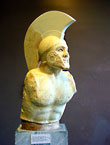 And so up
to Sparta to revisit old friends Georgios and Elizabeth at Castle View
Camping near Mystras. It had been a hard winter for them, with floods
from the Taigetos mountains causing much damage; but they welcomed us again
with oranges from their orchard. The Greek people have many paradoxical
ways (and why not - they invented the word), but their open-hearted
hospitality is humbling. Ancient Sparta, with its ruthless militaristic
constitution and economy dependent on serfdom of the Messinian Helots,
triumphed over Athens in the 5th century BC Peloponnesian War, but by
the early Christian era, was no more than a community of farming
villages in the broad Evrotas valley. The Franks had in 1250 AD
fortified the nearby 2000 feet precipitous hill of Mystras; as times
became more unsettled, the inhabitants from the valley sought safety around
the fortress and the town of Mystras grew up. The city flourished to
become a wealthy trading centre and seat of learning and the arts during
the final years of the Greek-Byzantine Empire under the Palaiologoi
emperors. Mystras survived only a few more years after the fall of
Constantinople to the Ottoman Turks in 1454. The scholars of Mystras
fled west, taking with them their knowledge and learning of Classical
Greek literature and philosophy, sowing the seeds of the Renaissance which
so changed the culture of Western civilisation, but left the Greeks to
languish under 350 years of Muslim barbarism. With Independence in 1831,
the modern town of Sparta was refounded, using as building material
stone blocks from Mystras which had originally been plundered from
Classical Sparta. Across 2000 years, the stones had come full circle.
And so up
to Sparta to revisit old friends Georgios and Elizabeth at Castle View
Camping near Mystras. It had been a hard winter for them, with floods
from the Taigetos mountains causing much damage; but they welcomed us again
with oranges from their orchard. The Greek people have many paradoxical
ways (and why not - they invented the word), but their open-hearted
hospitality is humbling. Ancient Sparta, with its ruthless militaristic
constitution and economy dependent on serfdom of the Messinian Helots,
triumphed over Athens in the 5th century BC Peloponnesian War, but by
the early Christian era, was no more than a community of farming
villages in the broad Evrotas valley. The Franks had in 1250 AD
fortified the nearby 2000 feet precipitous hill of Mystras; as times
became more unsettled, the inhabitants from the valley sought safety around
the fortress and the town of Mystras grew up. The city flourished to
become a wealthy trading centre and seat of learning and the arts during
the final years of the Greek-Byzantine Empire under the Palaiologoi
emperors. Mystras survived only a few more years after the fall of
Constantinople to the Ottoman Turks in 1454. The scholars of Mystras
fled west, taking with them their knowledge and learning of Classical
Greek literature and philosophy, sowing the seeds of the Renaissance which
so changed the culture of Western civilisation, but left the Greeks to
languish under 350 years of Muslim barbarism. With Independence in 1831,
the modern town of Sparta was refounded, using as building material
stone blocks from Mystras which had originally been plundered from
Classical Sparta. Across 2000 years, the stones had come full circle.