|
|
HUNGARIAN RHAPSODY - Part 1 |
||

|
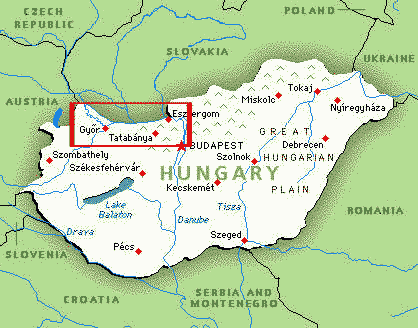
It's almost 1000 miles from the Channel coast to Hungary, 3 days' travel in constant rain. Our route through Belgium, Germany and Austria, allowed time for a brief visit to Vienna in passing. Camping Wien Süd was the usual crowded city site from where a combination of bus, tram and Unterbahn took us into the city. A day visit gave merely a sampling of the historic sites; it was clear however that the Habsburgs had for centuries bled the subject peoples of their Empire to adorn their capital with elaborate palaces and churches.
In continuing rain, we visited the Karlskirche, an architectural pot-pourri with 2 mock Trajan's Columns, and built in 1725 in thanks for Vienna having been spared the plague (Photo 1). The mighty Gothic extravaganza of St Stephen's Cathedral is certainly worth a visit, if only to ponder from the unsteady catwalk of the bell-tower how medieval technology managed such lofty construction. Our route followed the course of the Danube (Donau in Austria, Duna in Hungary). Europe's 2nd longest river after the Volga rises in the Black Forest and flows for 1,770 miles, on through Hungary and Romania to the Black Sea, a navigable trade route since medieval times. Buying our motorway matrica (vignette) and using our first Hungarian word - köszönöm (pronounced ker-ser-nerm) - thank you, we crossed the Hungarian border into the Kisalföld (Little Plain) flat-lands of the Danube valley. Suddenly all the signs seemed bewilderingly strange and place names unpronounceable. Our first stop was at Győr (pronounced Dy-ur). Although an industrial city with suburbs of high rise appartment blocks and factories, the attractive buildings and monuments clustered around the central square of Széchenyi ter showed the town's historic significance. The cathedral's prime treasure is a gilded reliquary bust of the 11th century canonised Magyar King Lászlo. Of the 3 campsites, we chose Kiskuti Kemping; the short bus ride into the town passed the Raba Engineering Works, one of modern Hungary's most successful industries. The campsite was, shall we say, a real experience: something of a retro-glimpse into Hungary's Communist past, with tiny chalets for workers' holidays and antiquated plumbing. If you plan to camp in Hungary, an essential piece of kit is a plastic shower hose/head from Poundsaver, modified to fit showers with no heads. Another pre-requisite is a good supply of Moontiger coils or Bagon to protect against biting midges. This stretch of the Danube forms the Hungarian/Slovak border, but the Börzsöny and Cserhát Hills cause the river to loop south, forming the so-called Danube Bend. The towns of this region which we visited over the next week are steeped in significance for Hungary's history. We camped for the St István (Stephen) Day national holiday fittingly at the historic town of Esztergom. It was here that the grandson of Arpád (who had led the Magyars into Hungary) Christianised the tribes, choosing significantly the Western Catholic rather than Eastern Orthodox church. His son, Vajk was crowned King Stephen (István) by the Pope's legate in 1000 AD in Esztergom where he later founded the Cathedral. The modern Basilica, a grandiose gilded marble neo-classical structure, dominates the town (Photo 2), and the Archbishop of Esztergom is Primate of Hungary. The Hungarian Church was persecuted during the Communist 1950s, but Esztergom's Basilica was spared, it was said, since Khrushchev's wife liked it. It was here that Cardinal Mindszenty was buried. He had defiantly opposed the Communists who imprisoned and tortured him, and in the 1956 Uprising, he sought asylum in the US Embassy in Budapest where he spent the next 15 years in internal exile. He died in Vienna in 1975, but willed that his body should not be returned to Hungary until the last Soviet troops had departed. The sweeping views from the Basilica dome across the Danube were truly inspirational (Photo 3). We shopped for provisions at a Tesco hypermarket - familiar surroundings but unfamiliar and unintelligible voices and signs. A little girl in the car park offered to return our trolley in exchange for the 100 forint coin; she'll do well in the new enterprise culture of modern Hungary. Gran Camping down by the Danube bridge was a comfortable base for the weekend; 8,100 forints a night sounded a huge amount but in fact came to just £12. The St Stephen's Eve firework display reflected along the Danube was a memorable experience, as were the celebrations around the Basilica over the holiday weekend. We moved along the Danube to the equally historical town of Visegrád, to camp close to river at the straightforward but welcoming Kék Duna Camping. Before the royal residence moved to Buda, Visegrád had been the seat of the early Magyar kings. Béla IV had built fortifications here in 1241 on the hill overlooking the Danube as protection against invading Mongols. Later rulers established the Royal Palace down by the river, The apogee came under Hungary's enlightened King Mátyás Corvinus who brought Renaissance art and culture to Hungary before his death in 1490. Whereas the Renaissance flourished in western Europe under such rulers as François I in France and Henry VIII in England, Hungary's Renaissance came to an abrupt end with the barbaric Turkish invasion of 1526 ushering in a 150 year dark ages for the unfortunate Hungarians. King Mátyás' Royal Palace, with its sensitively restored Italianate artwork and gardens, and the citadelle on the hilltop above gave a fascinating insight into Hungary's short-lived Renaissance.
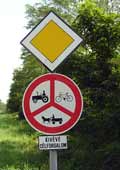
We have now been in Hungary over a week. The utterly unintelligible language is beginning to yield some of its secrets, but the multi-accented vowels, each with a unique sound, which if mis-pronounced can result in blank looks of non-comprehension. We are also getting used to distinctly Hungarian driving conditions - what would you make of this road sign? It is now time for us to follow the Danube further as it flows towards Hungary's capital, the combined cities of Buda and Pest. See our next edition in a week's time. Sheila and Paul Published: Saturday 27 August 2005
|

 But
then the rain started. We moved on to Pap Sziget Camping, set on an island
in the Danube at Szentendre (pronounced Sent Endray - St Andrew). And the
rain continued for 2 days, turning the campsite into liquid mud and the
roadways into mini-tributaries of the Danube. No wonder all the facilities
were raised on stilts 10 feet off the ground. Although Szentendre had some
interesting 17th century churches, founded by Serbian refugees from the
Turks, the town was a disappointment being an over-commercialised tourist
trap. Of greater interest was the nearby Hungarian Open-air Museum, or
Skanzen. During a lull in the rain, we drove out to find what Rough Guide
called 'steeples in a field'. On a large site, samples of rural
architecture from Hungary's different regions have been reassembled into
mini-villages to show traditional building methods and materials,
way of life, social structure, and working practices for the varying
communities. We had seen similar last year in Slovenia, but this was on a
huge scale and very worthwhile. And of course being Hungary, the
farmsteads had paprikas hanging up to dry (Photo 4).
But
then the rain started. We moved on to Pap Sziget Camping, set on an island
in the Danube at Szentendre (pronounced Sent Endray - St Andrew). And the
rain continued for 2 days, turning the campsite into liquid mud and the
roadways into mini-tributaries of the Danube. No wonder all the facilities
were raised on stilts 10 feet off the ground. Although Szentendre had some
interesting 17th century churches, founded by Serbian refugees from the
Turks, the town was a disappointment being an over-commercialised tourist
trap. Of greater interest was the nearby Hungarian Open-air Museum, or
Skanzen. During a lull in the rain, we drove out to find what Rough Guide
called 'steeples in a field'. On a large site, samples of rural
architecture from Hungary's different regions have been reassembled into
mini-villages to show traditional building methods and materials,
way of life, social structure, and working practices for the varying
communities. We had seen similar last year in Slovenia, but this was on a
huge scale and very worthwhile. And of course being Hungary, the
farmsteads had paprikas hanging up to dry (Photo 4).