|
|
HUNGARIAN RHAPSODY Week 6 |
||


|
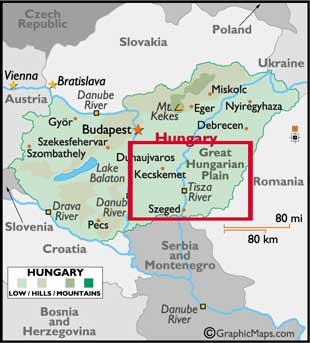
Rather wistfully, we left Szabolcs-Szatmar-Bereg county, and headed westwards through Nyírbátor and the county-town of Nyíregyháza towards the massive flatlands of central and southern Hungary - the Great Plain.
The Great Plain - Nagyalföld - covers half of the country, with the mighty River Tisza spreading sluggishly across its length, forming lakes and marshes, then flowing south-west towards Szeged and on to Serbia. The word Puszta, used now almost synonymously with Great Plain, means 'abandoned, deserted, bleak' and is an apt reflection of the transformation of the huge lowland Plain following the 16th century Turkish occupation. In medieval times, the Plain was thickly forested and the richly fertile land, irrigated by the Tisza and its tributaries, supported 100s of farming and livestock-rearing villages. But the devastating 150 years of Turkish barbarism brought almost total depopulation: forests were felled to build military stockades and deny covers to partisans. Denuded of vegetation, the land became marshy and infertile or further west, a barren sandy desert with only solitary herdsmen, runaway serfs or outlaws. It was a place to be avoided, hence the name Puszta. With improved flood control measures in the 19th century, the Plain became vast grassland steppes, suitable only as pastureland - a tough-living, wild-west with csikósok (cowboys) and remote wayside inns (csárdák). By the 20th century, the prairie lands were subsumed into massive estates with wealthy landowners driving out small farmers and herdsmen, resulting in large numbers of landless, workless peasants. Collective farming during the Communist regime did little to improve the peasants' lot; in spite of post-1989 economic upturn, greater continuity of agricultural production and more recently EEC membership, the central and eastern areas of the country have benefitted far less than the more prosperous western Hungary. Tourism is now an important source of income. A number of National Parks have been established across the breadth of the Great Plain, to protect the natural environment and present aspects of traditional ways of life, particularly animal husbandry and the incredible horsemanship skills of the herders.
The
following day, we crossed the Plain and the featureless Puszta looked
gloomier than ever with dismal low cloud and driving rain, to camp at
Gyula down by the Romanian border. Gyula is a jewel of a town, its name On the drive westwards to Szeged, we passed through Hódmezővásárhely (Hawd-mez-aw-var-shar-he-ye), which really must take the biscuit as the most unpronounceable name yet encountered! Partfürdő Camping at Szeged is on the banks of the River Tisza and disconcertingly the wrong (ie river-) side of the flood control levée; the campsite reportedly opens "in May, or later if the river is in flood". In Spring 2005, the river did in fact flood and the campsite was under 3m of water. Szeged's charming city centre, with its parks and delightful Art Nouveau buildings, dates from the disastrous 1879 Tisza floods when the city was totally destroyed. Franz Josef, the Habsburg emperor, gave the magnanimous commitment that "Szeged would rise again, more beautiful than ever" - and it did, rebuilt by Lajos Tsiza whose statue stands along with other national heroes in the central square, Széchenyi tér, alongside allegorical fountains representing the benevolent and destructive aspects of the River Tisza. We spent a happy day, admiring Szeged's monuments and charming buildings, among which was the Great Synagogue. Dating from 1900, it is one of the grandest in Europe (Photo 2), and unlike so many in Hungary, still in use, despite the murderous efforts of the Germans in 1944: 7,800 Jews from Szeged were deported to concentration camps and only 1,500 survived. Back in camp that evening, we took a dip in the open-air spa pool whose benzene-smelling 38ºC water rose from a bore-hole 1,550m deep. During the 1950s, geologists prospecting for oil managed to find only geothermal water, hence the large number of spas across Hungary. We now headed north, to Ópusztaszer National Historical Memorial Park, which commemorates the crossing of the 7 Magyar tribes into the Carpathian Basin in 896 AD led by Prince Árpád, the event known in Hungarian history as the honfoglalás, or land-taking. For Hungarians, clinging to the nationalistic associations of their Magyar roots, Ópusztaszer is a sacred place, the equivalent for us of Windsor Castle, Westminster Abbey, the Battle of Britain Memorial, Runnymede and Trooping of the Colour all rolled into one. It was the place chosen to mark the millennium celebrations of Hungary's nationhood in 1896, with the erection of the grandiosely classical Árpád Memorial, topped with the Magyar chieftain's statue with a feather in his cap. As part of the 1896 celebrations, a 360º panoramic painting was commissioned by Árpád Feszty, The Arrival of the Magyars, showing their triumphant conquest of Hungary and the land-taking. The painting was originally housed in Budapest but was badly damaged by WW II bombing and subsequent inept storage. It was admirably restored and is now displayed in a rotunda building at Ópusztaszer. It is a truly spectacular piece of work with the enormous circular vista opening before you on entering the darkened room: on a hillock, Árpád on his white horse surrounded by the 7 tribal chieftains surveys the victorious Magyar warriors (Photo 3) advancing across the plain and setting up camp. Nearby, Árpád's queen sits on a wagon drawn by 4 grey oxen such as we had seen at Hortobágy. The sheer scale and skillful presentation of the painting is truly breathtaking. After a brief visit to Kesckemét, another city with a rich heritage of beautiful Art Nouveau buildings and birthplace of the Hungarian composer Zoltán Kodály (1882~1967), we completed our crossing of the Great Plain to reach the valley of the Duna (Danube) at Kalocsa. This historical city is 1 of 2 episcopal seats established by King István in 1009. But its other claim to fame is that of being Hungary's Paprika Capital, the main producing area of the country's national spice. Paprika is richer in Vitamin C than citrus fruit, and it was from research on this that Albert Szent-György, Professor of Biochemistry at Szeged University, first synthesised Vitamin C, for which he was awarded the Nobel Prize for Medicine in 1937. At this time of the year, fields around the town blaze scarlet (Photo 4), and harvested paprika hangs to dry on cottage walls. Just to the south, we camped at Baja (the town which holds the world record for the greatest amount of fish soup cooked in 1 place at 1 time - remember you read it here first!) on Petőfi Island in the Danube, before crossing the enormous river bridge to begin the final phase of our Hungarian venture in Transdanubia. More of that in a couple of weeks, so stay in touch. Sheila and Paul Published: Wednesday 28 September 2005
|

 Puszta
Camping at Hortobágy was as bleak as the name implied: the weather turned
chill and a cold north- east wind howled across the flatlands, seeming
like the Magyars to have come all the way from the
Urals. The
Plain disappeared into distant horizons,
Puszta
Camping at Hortobágy was as bleak as the name implied: the weather turned
chill and a cold north- east wind howled across the flatlands, seeming
like the Magyars to have come all the way from the
Urals. The
Plain disappeared into distant horizons,
 the flatness only interrupted
by the occasional
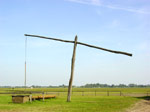
low barn or characteristically silhouetted draw-well. We
were taken out across the prairie in a horse-drawn wagon to see some of
the curious farm animals unique to the Puszta: woolly Mangalica pigs,
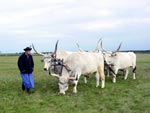
long-horned grey oxen and cork-screw horned Racka sheep. Then a
spectacular display of horsemanship by traditionally dressed herders (csikósok)
galloping bareback and cracking their whips. The highlight was the
Five-in-Hand display with the rider standing one foot on each of the hind
pair of horses and driving the leading 3 on long reins (Photo 1).
Contrived for the tourists it may have been, but it was still a mightily
impressive display of horse-handling skills, even more so in the
apparently remote setting of the wild and windy Puszta steppes. That
evening, to keep out the cold Puszta wind, we cooked hot gulyásleves
(goulash soup), washed down with local Szilva-pálinka (plum brandy).
the flatness only interrupted
by the occasional
low barn or characteristically silhouetted draw-well. We
were taken out across the prairie in a horse-drawn wagon to see some of
the curious farm animals unique to the Puszta: woolly Mangalica pigs,
long-horned grey oxen and cork-screw horned Racka sheep. Then a
spectacular display of horsemanship by traditionally dressed herders (csikósok)
galloping bareback and cracking their whips. The highlight was the
Five-in-Hand display with the rider standing one foot on each of the hind
pair of horses and driving the leading 3 on long reins (Photo 1).
Contrived for the tourists it may have been, but it was still a mightily
impressive display of horse-handling skills, even more so in the
apparently remote setting of the wild and windy Puszta steppes. That
evening, to keep out the cold Puszta wind, we cooked hot gulyásleves
(goulash soup), washed down with local Szilva-pálinka (plum brandy).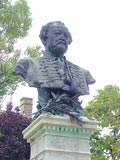 derived from a Magyar honorific meaning 'tribal chieftain'. As well as
being a spa centre, Gyula's cultural claim to fame is as the birth place of
the 19th century composer, Ferenc Erkel who wrote the music of the
Hungarian national anthem (played on the Prologue edition) and was teacher
to Béla Bartók. Erkel is honoured with a statue in the park (see
picture), and we
visited his home, now a museum with his manuscripts and memorabilia. Music
from his opera Bánk Bán features this week. We also uploaded our Week 5
web edition at the town's opulent library, taking advantage of the
government sponsored excellent @-Pont scheme: because of low public PC
ownership, internet access is available in public institutions, shops,
cafés and even private homes; you see the @ sign in every village, and
simply knock on the door of the 'teleház' to use the internet. Gyula also
has a charmingly traditional patisserie, the Százéves Cukrászda, furnished
in Biedermeier style and decorated in shades of crème de menthe and
chocolate (see slide-show on Home Page), a tasteful place for tea and
cream cakes.
derived from a Magyar honorific meaning 'tribal chieftain'. As well as
being a spa centre, Gyula's cultural claim to fame is as the birth place of
the 19th century composer, Ferenc Erkel who wrote the music of the
Hungarian national anthem (played on the Prologue edition) and was teacher
to Béla Bartók. Erkel is honoured with a statue in the park (see
picture), and we
visited his home, now a museum with his manuscripts and memorabilia. Music
from his opera Bánk Bán features this week. We also uploaded our Week 5
web edition at the town's opulent library, taking advantage of the
government sponsored excellent @-Pont scheme: because of low public PC
ownership, internet access is available in public institutions, shops,
cafés and even private homes; you see the @ sign in every village, and
simply knock on the door of the 'teleház' to use the internet. Gyula also
has a charmingly traditional patisserie, the Százéves Cukrászda, furnished
in Biedermeier style and decorated in shades of crème de menthe and
chocolate (see slide-show on Home Page), a tasteful place for tea and
cream cakes.