|
|
HUNGARIAN RHAPSODY Weeks 7~8 |
||

|
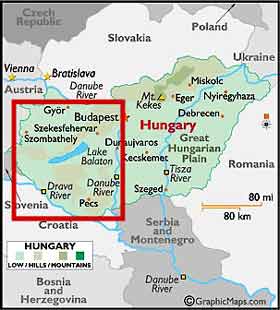
Crossing the Danube Bridge back into Transdanubia seemed a significant staging point, but we still had a lengthy 2 weeks more of travels ahead in Western Hungary.
The road climbed vine-covered hills which rose suddenly from the Duna (Danube)-Drava river plains, the highest land seen for 3 weeks. Our first visit was to the site of one of European history's most significant battles - Mohács - a name which for Hungarians conjures up images of defeat and degradation. Having captured Constantinople in 1453, the Turkish Ottoman Empire spread cancerously northwards through the Balkans during the 15th century. Their advance into central Europe was kept at bay by efficient military organisation and fortifications under the enlightened rule of King Mátyás Corvinus who had encouraged early Renaissance art and culture in Hungary. But after his death in 1490 incompetent rule, corruption and neglect of military governance left Hungary vulnerable to Muslim invasion. In 1526, the Turks advanced north from Serbia, to be faced at Mohács on Hungary's southern border by a small Magyar army led by the youthful Louis II. In the inevitably disastrous rout that followed, Sultan Sulieman's army massacred 25,000 Hungarians in 2 hours of butchery. With no further opposition, the Turks took Buda, and the way lay open to Vienna and onwards into Western Europe. The whole of Christian civilisation was in the balance against Muslim barbarism, almost 500 years before Sept 11 2001. The Mohács memorial was set up in 1976 to mark the 450th anniversary of the battle, on the site of mass graves of Hungarian dead. Modernistic carved wooden grave-markers symbolise the tragic events of March 29 1526 (Photo 1). Under heavily gloomy skies, we stood and paid our respects to those who had died defending Western European civilisation against the inexorable advance of Turkish barbarism. Just at the point when Renaissance enlightenment was taking root, Mohács was an overwhelmingly catastrophic turning point in Hungarian history. leading to a 150 year dark age of Turkish occupation and determining Hungary's tragic history for the next 500 years. Ironically the Turks were finally expelled from Hungary at nearby Siklós in 1687, but Hungary exchanged one foreign yoke for another - the Austrian Habsburgs, whose authoritarian rule lasted another 250 years. Being tied into alliance with Imperial Germany led to Hungarian defeat in WW I and the imposition by the victorious Allies of the punitive Treaty of Trianon (see Prologue edition of this web) which reduced Hungarian territory, natural resources and population by one half. Dalliance with Fascism under Miklós Horthy during the 1920s~30s drew Hungary again onto the loosing side in WW II, leading in 1945 to Soviet occupation and the repressive 40 years of Communist rule. Only the free elections of 1989 seemed to break Hungary free from the disastrous chain of consequences which flowed from the1526 catastrophic defeat at Mohács. We have learnt so much about Hungary's history and culture; standing quietly by the Mohács memorial was a poignant moment, and our way of showing due respect to the people whose guests we had been for the last 6 weeks. In a happier light, we spent a relaxed couple of days enjoying the delightful wines of the Siklós~Villány Wine Road. The area along the hills north of the Drava river was repopulated by Swabian German immigrants after the Turkish expulsion. They brought viticulturalist skills and new varieties of grapes which flourished on the south facing hillsides, making Villány one of the most successful wine producing regions of Hungary. In late September, the harvest was in full swing, with trailer loads of grapes being brought into the village for pressing. Here along the Croatian border was the most southerly point of our travels in Hungary. We headed
north of the hills to the southern city of Pécs (pronounced Paych),
staying at the small Familia Camping, a delightfully straightforward
family-run site in a walnut orchard; we gathered our Christmas nuts from
those freshly fallen by our camper. The no 31 bus took us into Pécs
centre, and as always, Hungarians were so helpful and courteous We passed
over the Mecsek Hills to Lake Balaton, landlocked Hungary's 'inland sea'.
In summer, this 'zimmer frei' jungle must be horrendous - one massive
German holiday camp. Fortunately in early October, all the heaving hoards
of holiday-makers have gone home leaving the area in peace. Near to
Kesthely at the western end of Balaton, we stayed But autumn was really setting in; it was now into October, evenings were cool and dewy, and campsites were beginning to close. It was time to be moving northwards over the Bakony Hills, back towards the Kisalföld where we started 7 weeks ago. On the way, we paused at Herend to visit the world-famous makers of hand-crafted porcelain ware. The products may not be to our taste (and certainly not to the price-constraints of our pocket) but it was a thoroughly impressive experience watching the skillful manufacture and painting of the porcelain. Queen Victoria ordered a 200 piece Herend dinner service at the Great Exhibition of 1851 though it is not reported what the ever-attentive Albert remarked. Close to Györ, we stayed at Píhenő Camping, set in woodland behind the family-run panzio. In the bar, it was a curious experience watching the Hungarian TV weather forecast which assured us that days would continue to be blessed with benignly warm autumn sunshine with nights chill and dewy. We had completed our circumnavigation of Hungary, past almost all the 7 bordering countries - Austria, Slovakia, Ukraine, Romania, Serbia, Croatia (just Slovenia to come). We were again close to the Slovakian border at Komárom. The town had been split into 2 by the diktats of Trianon in 1920, when the new border with what was then Czecho-slovakia was redrawn along the Danube, leaving ethnic Slovaks and Hungarians 'trapped' the wrong side of the line. We decided a day across the border was in order, so crossed the Danube (again) for lunch in Slovakia - the way you do, as Nicky said in her text message. Signs were dual-language and we heard as much Hungarian spoken as Slovak; and clearly Slovaks regularly walk across the bridge to shop at the new Tesco supermarket on the Hungarian bank. We'll shortly publish a final edition covering the last 2 weeks in Slovenia and a short stay at Venice. Sheila and Paul Published: Tuesday 11 October 2005
|

 to
visitors. Pécs is hyped as a city of art, education and culture. Under
Roman Imperial rule, the city was the capital of lower Pannonia, and after
the Magyar conquest, it became an episcopal seat and university centre.
The Turks expelled Hungarian residents and replaced the city's churches
with mosques. Pécs recovered its wealth and status during the 19th
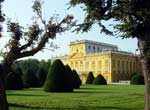
century and now possesses many elegant Art Nouveau buildings from that
period (Photo 2), including the magnificent Post
Office with stucco putties writing, posting and
delivering letters. Pécs
has an unprecedented number of museums and art galleries, the most
renowned of which is devoted to the works of Hungarian artist Kosztka
Tivader Csontváry (1853~1914). Having seen his work, the kindest
observation might be to sympathise with his suffering from schizophrenia;
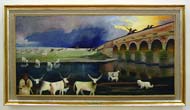
the one semi-worthwhile piece was 'Storm on the Hortobagy Puszta' (see
left), but this was not spectacular art. Despite the hype however, Pécs
was an enjoyable city.
to
visitors. Pécs is hyped as a city of art, education and culture. Under
Roman Imperial rule, the city was the capital of lower Pannonia, and after
the Magyar conquest, it became an episcopal seat and university centre.
The Turks expelled Hungarian residents and replaced the city's churches
with mosques. Pécs recovered its wealth and status during the 19th
century and now possesses many elegant Art Nouveau buildings from that
period (Photo 2), including the magnificent Post
Office with stucco putties writing, posting and
delivering letters. Pécs
has an unprecedented number of museums and art galleries, the most
renowned of which is devoted to the works of Hungarian artist Kosztka
Tivader Csontváry (1853~1914). Having seen his work, the kindest
observation might be to sympathise with his suffering from schizophrenia;
the one semi-worthwhile piece was 'Storm on the Hortobagy Puszta' (see
left), but this was not spectacular art. Despite the hype however, Pécs
was an enjoyable city.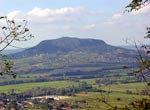 at Panorama Camping,
terraced up the hillside looking into the setting sun. Kept by a most
hospitable family, this ranked among the most pleasant we had used. Nearby Héviz had a remarkable natural phenomenon: not just a spa, but a whole
geothermally heated lake. In fact the only one bigger is in New Zealand.
Swimming in this was a relaxing way of passing Sunday morning, despite the
water allegedly being mildly radioactive - perhaps we shall now glow in
the dark. The hills to the north of Balaton are of spectacular volcanic
origin, formed by underwater eruptions when Central Europe lay under the
Pannonian Sea. The result today is a series of volcanic cones, such as
that at Badascony. We spent an invigorating afternoon walking the
way-marked paths around the volcanic cone, admiring its basalt columns and
pumice, exposed by quarrying. And to conclude the afternoon, a glass (or
2) of the local dry Olaz-rizling wine, produced from the vines which cover
the lower slopes overlooking Balaton (Photo
3).
at Panorama Camping,
terraced up the hillside looking into the setting sun. Kept by a most
hospitable family, this ranked among the most pleasant we had used. Nearby Héviz had a remarkable natural phenomenon: not just a spa, but a whole
geothermally heated lake. In fact the only one bigger is in New Zealand.
Swimming in this was a relaxing way of passing Sunday morning, despite the
water allegedly being mildly radioactive - perhaps we shall now glow in
the dark. The hills to the north of Balaton are of spectacular volcanic
origin, formed by underwater eruptions when Central Europe lay under the
Pannonian Sea. The result today is a series of volcanic cones, such as
that at Badascony. We spent an invigorating afternoon walking the
way-marked paths around the volcanic cone, admiring its basalt columns and
pumice, exposed by quarrying. And to conclude the afternoon, a glass (or
2) of the local dry Olaz-rizling wine, produced from the vines which cover
the lower slopes overlooking Balaton (Photo
3). Finally we
had Western Hungary to visit to complete our tour. Close to Györ, we found a small market in the village of
Nyúl
which set us up in vegetables for the next few days (Photo 4).The Benedictine
Monastery at Pannonhalma, gazing out across the Pannonian Plain and run by
worldly-wise monks with an eye on profit, rips off the coach loads of
tourists by charging outrageous prices to visit the hill-top temple. We
paid up our 2000 forints each, but was it worth it ... ? By
contrast Sopron in lovely autumn sunshine was a sheer delight; over the centuries, the town managed
to avoid undue damage by Mongols, Turks, Austrians, Germans and Soviets.
It also achieved the impossible by
Finally we
had Western Hungary to visit to complete our tour. Close to Györ, we found a small market in the village of
Nyúl
which set us up in vegetables for the next few days (Photo 4).The Benedictine
Monastery at Pannonhalma, gazing out across the Pannonian Plain and run by
worldly-wise monks with an eye on profit, rips off the coach loads of
tourists by charging outrageous prices to visit the hill-top temple. We
paid up our 2000 forints each, but was it worth it ... ? By
contrast Sopron in lovely autumn sunshine was a sheer delight; over the centuries, the town managed
to avoid undue damage by Mongols, Turks, Austrians, Germans and Soviets.
It also achieved the impossible by