The tiny
town of Erice nestles atop an 800m high mountain, approached by winding
hair-pins, and the panoramic views northwards across Bonagia Bay to our
last night's wild camp under Monte Cofano were stunning. Like Segesta,
Erice was founded originally by Elymians who claimed descent from Trojan
refugees, but over its history given its strategic position, the city
was ruled by Carthaginians, Romans, Saracens and Normans, who all left
their mark.
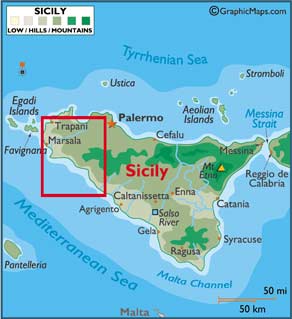
Click on highlighted area
for details of SW Sicily
Despite being something of a tourist trap, the
narrow streets
were
deserted. We
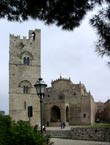
threaded our way through the cobbled alleyways, exploring the Norman
castle perched on precipitous crags, the 13th century Duomo and its
bell-tower, remains of Carthaginian fortifications, and delightfully
restored medieval churches. The church of San Giuliano contained the
wooden statue-groups (Mysteri) portraying scenes from the Crucifixion,
which are processed around the town during the Easter celebrations (Photo 1).
Despite
being the provincial capital, Trapani is an unattractive city surrounded
by apartment blocks. We did however manage
to
find what for us were its 2 highlights: a supermarket open on a Saturday
afternoon (we badly needed weekend shopping) and the road out of town
south.
Glad
to leave behind the urban sprawl, we turned down to the coast opposite
the island of Mozia, site of a Phoenician trading settlement dating from
the 8th century BC. The lagoons along this coastline still support the
remains of a traditional industry, salt production. Salt is recovered
from saltpans and piled in heaps covered by pan-tiles; flimsy-looking
windmills once provided power to pump rich saline water from the shallow
pans and to break up the dried crust of salt formed as the water
evaporated (Photo 2). Here in an idyllic setting looking out
through reeds and bamboo over the saltpans, we enjoyed a memorable
wild-camp with a glowing sunset across the western sea.
Mozia was
destroyed by Syracusan Greeks in 397 BC and the survivors re-settled on
the nearby mainland at what became the city of Marsala. It was from here
that later the Romans launched the expedition which finally destroyed
Carthage on the N African coast. In the mid-19th century, Garibaldi
landed at Marsala with his 1000 Redshirts to begin the campaign to rid
Sicily of Bourbon rule leading to the unification of Italy. The city had
also gained fame for its production of Marsala fortified wines, an
industry established by English merchant venturers. On a sunny Sunday
morning, we drove into Marsala to visit its Baroque centre and
exceptional Archaeological Museum, and to taste its renowned wines.
Marsala's
Archaeological Museum, in a stone-vaulted former wine warehouse, houses
a unique exhibit: the remains of a Phoenician Liburnian, a light warship
dating from the 3rd century BC and sunk during the First
Punic War with Rome. The wooden vessel was recovered by English marine
archaeologists in the late 1990s; 35m long with a crew of 68 oarsmen, it
was smaller than a Greek trireme but much faster and manoeuvrable. The
sections of recovered timberwork from the hull, keel and stern-post are
displayed set within a metal frame to give an impression of the
warship's overall shape and size (Photo 3). The display
is
enlivened by excellent explanatory panels with English translation;
whether archaeology is your 'thing' or not, this
superb piece of history merits a visit if you come to Marsala.
Marsala is
an elegant place, less care-worn than most Sicilian cities, with huge
palm trees gracing its lungomare (sea-front). The commemorative Porta
Garibaldi leads into the Baroque centre (Photo 4), but even the
churches were closed on a Sunday afternoon and the attractive streets
deserted. We did eventually find a place to sample Marsala fortified
wines but really could not say it was to our taste. It remained only to
stand at Capo Boeo on the seaward edge of the town, Sicily's extreme
western point; here we were closer to N Africa than to the Italian
mainland.
After
several nights of wild-camping and 3 weeks on the road, we needed a good
campsite as the base for the
next few days. Camping Biscione
at Petrosino south of Marsala seemed a
tropical paradise, close to the coast with green open spaces, exotic
flowers and flourishing palm trees. At €15/night, it was peaceful and
welcoming, and thoroughly recommended. It is important however to add
the caveat that prices quoted and our campsite recommendations relate to
stays in March/April. In the fierce heat of Sicilian summer, prices will
inevitably be higher and campsites filled beyond capacity with
insufferable noise levels. And another tip: always ask for a 'sconto'
(discount) on any excuse (Camping Carnet, reduced facilities out of
season); chances are you'll get a few €s off, but not if you don't ask.
Biscione was an idyllic haven, spoilt only by a change in the weather:
that evening, the sky blackened, the wind increased, and the forecast bad
weather hit with a vengeance. Lashing rain, cold gusting winds and
electrical storms buffeted our camper and ravaged the palm fronds like a
tropical hurricane. This continued for 36 hours. We had chosen well for
a much needed 'rest day' to update the web site and catch up with
household jobs.
Mazara del
Vallo, the next sizeable town along the SW coast, was the first Sicilian
settlement to be captured by the Saracens and after prospering for 250
years, was the last to surrender to the Normans in 1087. Arab links have
been revived in recent years with Tunisian immigrants flocking into the
port as cheap labour for Italy's largest fishing fleet based at Mazara.
Unsure about the town traffic, we parked along the sea-front and walked
into town. The façade of the bulky Duomo, mainly Norman but elaborated
by a lusty Baroque make-over, bears a satisfyingly politically-incorrect
relief of the Norman King Roger trampling underfoot a Saracen (Photo
5). We recommend the incongruously named Lo Scoiattolo (Squirrel) for an excellent value lunch; try the local Couscous di Pesce (swordfish
with a piquant tomato sauce). Behind the busy port crammed with old
hulks, the kasbah-like Tunisian quarter is filled with dingy alleyways
and Arabic shops, an interesting if not comfortable place to wonder. The
town's highlight should have been the Museo del Satiro, displaying a
superb 4th century BC bronze statue of a satyr in ecstatic Dionysian
revel, and dredged up from the seabed in 1998. The notice on the locked
museum door stated that just last week, this treasure had gone on
display at the Paris Louvre; so disappointed, we had to satisfy
ourselves instead with a provisions stock-up at a supermarket on the
town's outskirts.
The sky
was still black and the squally wind gusting as we moved further round
the coast to Selinunte, across the undulating coastal plain planted with
vines and olive groves. With the unsettled weather continuing, we camped
at Campeggio Athena near to the tiny fishing harbour of Marinella. Our
reason for
coming here was to visit the archaeological site of Selinunte, ancient
Selinos. This most westerly Greek city along the southern Sicilian
seaboard was founded in the 7th century BC by colonists from Megara
Hyblaea near to Syracuse and named Selinos from the Greek word for wild
celery which grows in profusion around the river mouth which formed the
city's harbour. Selinos' prosperity from its fertile hinterland brought
territorial conflict with Segesta and its allies the Carthaginians who
in 409 BC razed Selinos and butchered its citizens. The city had covered
a large area, now only partly excavated, but its wealth is evident from
the 2 areas of sumptuous temples, some partially restored, others simply
random heaps of debris from the city's sack and subsequent earthquake
damage. The
deities to whom the Selinos temples were dedicated is unknown, and they
are now simply labelled as Temples A~G. Temple E was reconstructed in
1957; the limestone structure glowed golden in the fleeting sunlight,
set amid bright yellow crown daisies and Opuntia (Photo 6). We
clambered amid the heaps of gigantic stone blocks and column drums from
the temples' debris, marvelling at their enormous scale, the mammoth
task of
reconstruction and the elegance of the restored temples. This
was further reinforced by a visit to the nearby Cave di Cusa, the
ancient quarries from which the temples' stone components were
extracted . Follow the signs from the small town of Campobello de Mazara;
here a path winds among tufa outcrops and olive groves where in the 5th
century BC, masons worked to cut and shape blocks of stone for Selinunte's temples construction. Massive incomplete column drums, some
cut, others just stumps, lay randomly scattered; one could poignantly
imagine this as a busy working quarry, suddenly abandoned when the Carthaginians
brutally sacked Selinos in 409 BC, leaving the temples uncompleted.
Spring weather finally arrived bringing long-awaited warm sunshine. The
campsite leaflet optimistically proclaimed: Sicilia dove l'estato
dura tutto l'anno. We hoped it was right as we moved eastwards past
the squalid little town of Menfi which still bore signs of unrepaired
earthquake damage from 1968. The road wove a serpentine course across
fertile coastal plains planted with olives, vines and citrus, to
Sciacca. A busy fishing port, its walled upper town is virtually
untouched by tourism but preserves a number of interesting if care-worn
historical buildings. Again our timing was not of the best, our visit
coinciding with siesta time when streets are deserted and shops closed.
The town also has a distinctive ceramics industry, and a flight of steps
leading from the port to the upper town is decorated with brightly
patterned tiles, each riser the work of different ceramics workshops (Photo 7).
Along the
coast we camped at Camping Kameni at the small resort of Secca Grande.
This would once have been a pleasant site, shaded by exotic trees
and shrubs; now it was sorely neglected, crammed
full of squalid statics for the hoards who during summer would be
shoe-horned in to entertain one another with the noise of their
satellite TVs. With minimal facilities and just a small rubbish-strewn
patch for campers, it is a place to be avoided; we might as well have
wild-camped. But at least it provided a base to visit 2 memorable
places: one was the small unspoilt town of Ribera, billed as 'City of
the Orange' from the endless orange groves in the area; the other was
the most attractively positioned archaeological site in Sicily, the remains
of ancient Eraclea Minoa. Ribera on a Saturday morning was delightful.
We wandered through the grid of narrow streets, doing our shopping like
others in the town; and of course, being Ribera, we had to buy local
oranges - a whole bagful of the biggest, juiciest fruits ever seen, all
for €1. The most unpretentious of towns, and perhaps less run-down than
many in Sicily, Ribera left us with happy memories.
So too did
Eraclea Minoa. Founded by Cretan colonists, the city flourished in the
4th
century BC from when the scant remains date. But it's the setting which
so overawes, perched on a headland above gleaming white marl
cliffs, overlooking a glorious arc of unspoilt golden beaches (Photo
8). We followed the path around the cliff tops to the aptly named
Capo Bianco, amid an exotic paradise of fearsome woody Opuntia, spiky
agave with tall buds rearing skywards, bright yellow crown daisies,
scented wild sweet peas, glowing yellow mimosa and bushes of acacia with
vicious spines. And down at the beach, fringed with pines, eucalyptus
and tamarisk and deserted at this time of year, crashing waves pounded
the golden sand. This was the perfect climax to a fabulous week of
travels.
It was now time for us to move on into Sicily's mountainous western
interior, particularly to visit a town with chilling associations -
Corleone. Follow our ventures in next week's edition of our travelogue
web site.



 Despite being something of a tourist trap, the
narrow streets
were
deserted. We
threaded our way through the cobbled alleyways, exploring the Norman
castle perched on precipitous crags, the 13th century Duomo and its
bell-tower, remains of Carthaginian fortifications, and delightfully
restored medieval churches. The church of San Giuliano contained the
wooden statue-groups (Mysteri) portraying scenes from the Crucifixion,
which are processed around the town during the Easter celebrations (Photo 1).
Despite being something of a tourist trap, the
narrow streets
were
deserted. We
threaded our way through the cobbled alleyways, exploring the Norman
castle perched on precipitous crags, the 13th century Duomo and its
bell-tower, remains of Carthaginian fortifications, and delightfully
restored medieval churches. The church of San Giuliano contained the
wooden statue-groups (Mysteri) portraying scenes from the Crucifixion,
which are processed around the town during the Easter celebrations (Photo 1).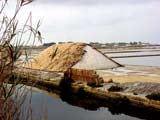 the island of Mozia, site of a Phoenician trading settlement dating from
the 8th century BC. The lagoons along this coastline still support the
remains of a traditional industry, salt production. Salt is recovered
from saltpans and piled in heaps covered by pan-tiles; flimsy-looking
windmills once provided power to pump rich saline water from the shallow
pans and to break up the dried crust of salt formed as the water
evaporated (Photo 2). Here in an idyllic setting looking out
through reeds and bamboo over the saltpans, we
the island of Mozia, site of a Phoenician trading settlement dating from
the 8th century BC. The lagoons along this coastline still support the
remains of a traditional industry, salt production. Salt is recovered
from saltpans and piled in heaps covered by pan-tiles; flimsy-looking
windmills once provided power to pump rich saline water from the shallow
pans and to break up the dried crust of salt formed as the water
evaporated (Photo 2). Here in an idyllic setting looking out
through reeds and bamboo over the saltpans, we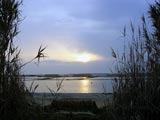 enjoyed a memorable
wild-camp with a glowing sunset across the western sea.
enjoyed a memorable
wild-camp with a glowing sunset across the western sea. Marsala's
Archaeological Museum, in a stone-vaulted former wine warehouse, houses
a unique exhibit: the remains of a Phoenician Liburnian, a light warship
dating from the 3rd century BC and sunk during the First
Marsala's
Archaeological Museum, in a stone-vaulted former wine warehouse, houses
a unique exhibit: the remains of a Phoenician Liburnian, a light warship
dating from the 3rd century BC and sunk during the First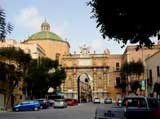 Punic War with Rome. The wooden vessel was recovered by English marine
archaeologists in the late 1990s; 35m long with a crew of 68 oarsmen, it
was smaller than a Greek trireme but much faster and manoeuvrable. The
sections of recovered timberwork from the hull, keel and stern-post are
displayed set within a metal frame to give an impression of the
warship's overall shape and size (Photo 3). The display
is
enlivened by excellent explanatory panels with English translation;
whether archaeology is your 'thing' or not, this
superb piece of history merits a visit if you come to Marsala.
Punic War with Rome. The wooden vessel was recovered by English marine
archaeologists in the late 1990s; 35m long with a crew of 68 oarsmen, it
was smaller than a Greek trireme but much faster and manoeuvrable. The
sections of recovered timberwork from the hull, keel and stern-post are
displayed set within a metal frame to give an impression of the
warship's overall shape and size (Photo 3). The display
is
enlivened by excellent explanatory panels with English translation;
whether archaeology is your 'thing' or not, this
superb piece of history merits a visit if you come to Marsala. Petrosino south of Marsala seemed a
tropical paradise, close to the coast with green open spaces, exotic
flowers and flourishing palm trees. At €15/night, it was peaceful and
welcoming, and thoroughly recommended. It is important however to add
the caveat that prices quoted and our campsite recommendations relate to
stays in March/April. In the fierce heat of Sicilian summer, prices will
inevitably be higher and campsites filled beyond capacity with
insufferable noise levels. And another tip: always ask for a 'sconto'
(discount) on any excuse (Camping Carnet, reduced facilities out of
season); chances are you'll get a few €s off, but not if you don't ask.
Biscione was an idyllic haven, spoilt only by a change in the weather:
that evening, the sky blackened, the wind increased, and the forecast bad
weather hit with a vengeance. Lashing rain, cold gusting winds and
electrical storms buffeted our camper and ravaged the palm fronds like a
tropical hurricane. This continued for 36 hours. We had chosen well for
a much needed 'rest day' to update the web site and catch up with
household jobs.
Petrosino south of Marsala seemed a
tropical paradise, close to the coast with green open spaces, exotic
flowers and flourishing palm trees. At €15/night, it was peaceful and
welcoming, and thoroughly recommended. It is important however to add
the caveat that prices quoted and our campsite recommendations relate to
stays in March/April. In the fierce heat of Sicilian summer, prices will
inevitably be higher and campsites filled beyond capacity with
insufferable noise levels. And another tip: always ask for a 'sconto'
(discount) on any excuse (Camping Carnet, reduced facilities out of
season); chances are you'll get a few €s off, but not if you don't ask.
Biscione was an idyllic haven, spoilt only by a change in the weather:
that evening, the sky blackened, the wind increased, and the forecast bad
weather hit with a vengeance. Lashing rain, cold gusting winds and
electrical storms buffeted our camper and ravaged the palm fronds like a
tropical hurricane. This continued for 36 hours. We had chosen well for
a much needed 'rest day' to update the web site and catch up with
household jobs.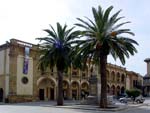 Mazara del
Vallo, the next sizeable town along the SW coast, was the first Sicilian
settlement to be captured by the Saracens and after prospering for 250
years, was the last to surrender to the Normans in 1087. Arab links have
been revived in recent years with Tunisian immigrants flocking into the
port as cheap labour for Italy's largest fishing fleet based at Mazara.
Unsure about the town traffic, we parked along the sea-front and walked
into town. The façade of the bulky Duomo, mainly Norman but elaborated
by a lusty Baroque make-over, bears a satisfyingly politically-incorrect
relief of the Norman King Roger trampling underfoot a Saracen (Photo
5). We recommend the incongruously named Lo Scoiattolo (Squirrel) for an excellent value lunch; try the local Couscous di Pesce (swordfish
with a piquant tomato sauce). Behind the busy port crammed with old
hulks, the kasbah-like Tunisian quarter is filled with dingy alleyways
and Arabic shops, an interesting if not comfortable place to wonder. The
town's highlight should have been the Museo del Satiro, displaying a
superb 4th century BC bronze statue of a satyr in ecstatic Dionysian
revel, and dredged up from the seabed in 1998. The notice on the locked
museum door stated that just last week, this treasure had gone on
display at the Paris Louvre; so disappointed, we had to satisfy
ourselves instead with a provisions stock-up at a supermarket on the
town's outskirts.
Mazara del
Vallo, the next sizeable town along the SW coast, was the first Sicilian
settlement to be captured by the Saracens and after prospering for 250
years, was the last to surrender to the Normans in 1087. Arab links have
been revived in recent years with Tunisian immigrants flocking into the
port as cheap labour for Italy's largest fishing fleet based at Mazara.
Unsure about the town traffic, we parked along the sea-front and walked
into town. The façade of the bulky Duomo, mainly Norman but elaborated
by a lusty Baroque make-over, bears a satisfyingly politically-incorrect
relief of the Norman King Roger trampling underfoot a Saracen (Photo
5). We recommend the incongruously named Lo Scoiattolo (Squirrel) for an excellent value lunch; try the local Couscous di Pesce (swordfish
with a piquant tomato sauce). Behind the busy port crammed with old
hulks, the kasbah-like Tunisian quarter is filled with dingy alleyways
and Arabic shops, an interesting if not comfortable place to wonder. The
town's highlight should have been the Museo del Satiro, displaying a
superb 4th century BC bronze statue of a satyr in ecstatic Dionysian
revel, and dredged up from the seabed in 1998. The notice on the locked
museum door stated that just last week, this treasure had gone on
display at the Paris Louvre; so disappointed, we had to satisfy
ourselves instead with a provisions stock-up at a supermarket on the
town's outskirts.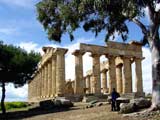 The sky
was still black and the squally wind gusting as we moved further round
the coast to Selinunte, across the undulating coastal plain planted with
vines and olive groves. With the unsettled weather continuing, we camped
at Campeggio Athena near to the tiny fishing harbour of Marinella. Our
reason for
coming here was to visit the archaeological site of Selinunte, ancient
Selinos. This most westerly Greek city along the southern Sicilian
seaboard was founded in the 7th century BC by colonists from Megara
Hyblaea near to Syracuse and named Selinos from the Greek word for wild
celery which grows in profusion around the river mouth which formed the
city's harbour. Selinos' prosperity from its fertile hinterland brought
territorial conflict with Segesta and its allies the Carthaginians who
in 409 BC razed Selinos and butchered its citizens. The city had covered
a large area, now only partly excavated, but its wealth is evident from
the 2 areas of sumptuous temples, some partially restored, others simply
random heaps of debris from the city's sack and subsequent earthquake
damage. The
deities to whom the Selinos temples were dedicated is
The sky
was still black and the squally wind gusting as we moved further round
the coast to Selinunte, across the undulating coastal plain planted with
vines and olive groves. With the unsettled weather continuing, we camped
at Campeggio Athena near to the tiny fishing harbour of Marinella. Our
reason for
coming here was to visit the archaeological site of Selinunte, ancient
Selinos. This most westerly Greek city along the southern Sicilian
seaboard was founded in the 7th century BC by colonists from Megara
Hyblaea near to Syracuse and named Selinos from the Greek word for wild
celery which grows in profusion around the river mouth which formed the
city's harbour. Selinos' prosperity from its fertile hinterland brought
territorial conflict with Segesta and its allies the Carthaginians who
in 409 BC razed Selinos and butchered its citizens. The city had covered
a large area, now only partly excavated, but its wealth is evident from
the 2 areas of sumptuous temples, some partially restored, others simply
random heaps of debris from the city's sack and subsequent earthquake
damage. The
deities to whom the Selinos temples were dedicated is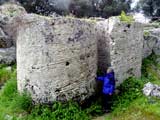 unknown, and they
are now simply labelled as Temples A~G. Temple E was reconstructed in
1957; the limestone structure glowed golden in the fleeting sunlight,
set amid bright yellow crown daisies and Opuntia (Photo 6). We
clambered amid the heaps of gigantic stone blocks and column drums from
the temples' debris, marvelling at their enormous scale, the mammoth
task of
reconstruction and the elegance of the restored temples. This
was further reinforced by a visit to the nearby Cave di Cusa, the
ancient quarries from which the temples' stone components were
extracted . Follow the signs from the small town of Campobello de Mazara;
here a path winds among tufa outcrops and olive groves where in the 5th
century BC, masons worked to cut and shape blocks of stone for Selinunte's temples construction. Massive incomplete column drums, some
cut, others just stumps, lay randomly scattered; one could poignantly
imagine this as a busy working quarry, suddenly abandoned when the Carthaginians
brutally sacked Selinos in 409 BC, leaving the temples uncompleted.
unknown, and they
are now simply labelled as Temples A~G. Temple E was reconstructed in
1957; the limestone structure glowed golden in the fleeting sunlight,
set amid bright yellow crown daisies and Opuntia (Photo 6). We
clambered amid the heaps of gigantic stone blocks and column drums from
the temples' debris, marvelling at their enormous scale, the mammoth
task of
reconstruction and the elegance of the restored temples. This
was further reinforced by a visit to the nearby Cave di Cusa, the
ancient quarries from which the temples' stone components were
extracted . Follow the signs from the small town of Campobello de Mazara;
here a path winds among tufa outcrops and olive groves where in the 5th
century BC, masons worked to cut and shape blocks of stone for Selinunte's temples construction. Massive incomplete column drums, some
cut, others just stumps, lay randomly scattered; one could poignantly
imagine this as a busy working quarry, suddenly abandoned when the Carthaginians
brutally sacked Selinos in 409 BC, leaving the temples uncompleted.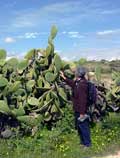 Along the
coast we camped at Camping Kameni at the small resort of Secca Grande.
This would once have been a pleasant site, shaded by exotic trees
and shrubs; now it was sorely neglected, crammed
full of squalid statics for the hoards who during summer would be
shoe-horned in to entertain one another with the noise of their
satellite TVs. With minimal facilities and just a small rubbish-strewn
patch for campers, it is a place to be avoided; we might as well have
wild-camped. But at least it provided a base to visit 2 memorable
places: one was the small unspoilt town of Ribera, billed as 'City of
the Orange' from the endless orange groves in the area; the other was
the most attractively positioned archaeological site in Sicily, the remains
of ancient Eraclea Minoa. Ribera on a Saturday morning was delightful.
We wandered through the grid of narrow streets, doing our shopping like
others in the town; and of course, being Ribera, we had to buy local
oranges - a whole bagful of the biggest, juiciest fruits ever seen, all
for €1. The most unpretentious of towns, and perhaps less run-down than
many in Sicily, Ribera left us with happy memories.
Along the
coast we camped at Camping Kameni at the small resort of Secca Grande.
This would once have been a pleasant site, shaded by exotic trees
and shrubs; now it was sorely neglected, crammed
full of squalid statics for the hoards who during summer would be
shoe-horned in to entertain one another with the noise of their
satellite TVs. With minimal facilities and just a small rubbish-strewn
patch for campers, it is a place to be avoided; we might as well have
wild-camped. But at least it provided a base to visit 2 memorable
places: one was the small unspoilt town of Ribera, billed as 'City of
the Orange' from the endless orange groves in the area; the other was
the most attractively positioned archaeological site in Sicily, the remains
of ancient Eraclea Minoa. Ribera on a Saturday morning was delightful.
We wandered through the grid of narrow streets, doing our shopping like
others in the town; and of course, being Ribera, we had to buy local
oranges - a whole bagful of the biggest, juiciest fruits ever seen, all
for €1. The most unpretentious of towns, and perhaps less run-down than
many in Sicily, Ribera left us with happy memories.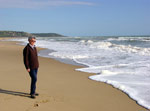 So too did
Eraclea Minoa. Founded by Cretan colonists, the city flourished in the
4th
century BC from when the scant remains date. But it's the setting which
so overawes, perched on a headland above gleaming white marl
cliffs, overlooking a glorious arc of unspoilt golden beaches (Photo
8). We followed the path around the cliff tops to the aptly named
Capo Bianco, amid an exotic paradise of fearsome woody Opuntia, spiky
agave with tall buds rearing skywards, bright yellow crown daisies,
scented wild sweet peas, glowing yellow mimosa and bushes of acacia with
vicious spines. And down at the beach, fringed with pines, eucalyptus
and tamarisk and deserted at this time of year, crashing waves pounded
the golden sand. This was the perfect climax to a fabulous week of
travels.
So too did
Eraclea Minoa. Founded by Cretan colonists, the city flourished in the
4th
century BC from when the scant remains date. But it's the setting which
so overawes, perched on a headland above gleaming white marl
cliffs, overlooking a glorious arc of unspoilt golden beaches (Photo
8). We followed the path around the cliff tops to the aptly named
Capo Bianco, amid an exotic paradise of fearsome woody Opuntia, spiky
agave with tall buds rearing skywards, bright yellow crown daisies,
scented wild sweet peas, glowing yellow mimosa and bushes of acacia with
vicious spines. And down at the beach, fringed with pines, eucalyptus
and tamarisk and deserted at this time of year, crashing waves pounded
the golden sand. This was the perfect climax to a fabulous week of
travels.