 SLOVENIA
- 30 years on
SLOVENIA
- 30 years on
Prologue Photos Bottom of page
Return to Index-page
|
Prologue to our
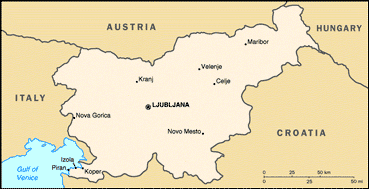
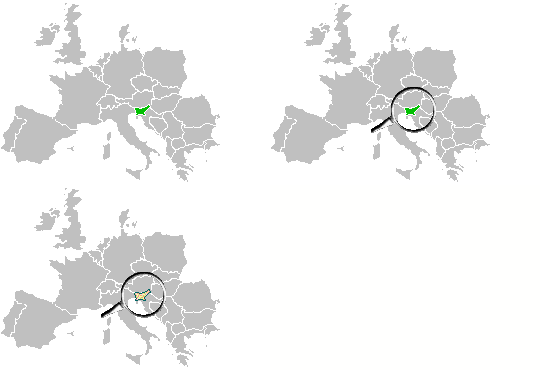
forthcoming Slovenian trip: So where exactly is Slovenia?
Sandwiched between Austria, Italy, Hungary and Croatia, it is one of Europe's smallest countries, less than 21,000 square kilometres, half the size of Switzerland and about the same size as Wales, with a population of 2 million people. 40% of the country is mountainous, a quarter of which is alpine. Firstly, let's debunk a couple of misconceptions about Slovenia: 1) it's not only George W Bush who makes the lamentable goof of mistaking Slovenia for Slovakia (the Slovak Republic, part of former Czechoslovakia) - even the bank got confused and tried to sell us Slovakian korunas rather than Slovenian tolars, and 2) although Slovenia was formerly part of the Federal Republic of Yugoslavia, it has never suffered from the instability, turmoil and barbaric conflict which embroiled the southern Balkans during the 1990s. Historically, Slovenia had been part of the Austro-Hungarian Habsburg Empire, and although a Slavic nation, it has always had close cultural and economic associations with central Europe, unlike Bosnia and Serbia further south who were previously ruled by the Turkish Ottoman Empire and therefore had a significant Muslim population. Even before Slovenia's comparatively peaceful secession from the fragmenting Yugoslavian federation in 1991, it has always been a safe place to visit; we certainly felt quite comfortably at home there in 1974, despite its then being nominally a Communist state. Since gaining its independence, Slovenia has prospered and is now a fully fledged member of the EEC and NATO. The main reasons for our 1974 visit were the superb mountaineering opportunities offered by the Julian Alps in the NW corner of Slovenia. Our intention had been to make a 2 week circuit through the mountains, using the mountain huts operated by the Slovenian Alpine Association. But the weather in the summer of 1974 was uncharacteristically poor, and much of the time, we were in cloud and rain. It was in weather conditions like this that we climbed Triglav, Slovenia's highest peak at 2,864m, but regrettably the poor visibility spoilt any chance of photographing the superb terrain during the knife-edge ascent. We took colour slides back in 1974, and although the quality has dimmed a bit with the passing years (and the poor weather conditions at the time), we have scanned a small selection for inclusion in this Prologue web site. Our first car which we used for the 1974 trip was a Hillman Imp. Nicky and Lucy will frequently have heard us talk nostalgically of The Little Green Imp, but they have never previously seen a photo - well here's the chance (see Photo 1). Photo 2 shows the beautiful Bohinj Lake, one of the jewels of the Triglav National Park. Photo 3 shows the glacier on the north face of the mighty Triglav (which figures on the Slovenian national flag); we climbed the 9,395 feet peak from the mountain hut Triglavski Dom which is set on a ledge below the summit at around 7,500 feet. Photo 4 shows a very flattering portrait of Sheila taken on the return ferry journey. We set off on our re-visit to Slovenia towards the end of July, and again plan to publish fortnightly updates of our travel news and pictures on this web site. Slovenian music is a little more hard to come by, so be prepared for whatever musical accompaniments come to hand. As with the Greek trip, we are anxious to exploit our visit fully not only to see as much of the country as possible, but as importantly to learn more about contemporary Slovenian culture and society, and particularly to master a little of their language with its extraordinarily difficult pronunciation - overfull of z's, c's and s's and a distinct shortage of vowels in most words as it seems. As the days shorten in later September, we shall head westwards, pausing a few days to re-visit Venice, and ending the trip on home territory in France, probably the Loire valley. So these are our plans. We do hope you will enjoy sharing the venture with us through the medium of our web site, and as before, do please email us to keep in touch. Sheila and Paul Published: Monday 12 July 2004
|
 <Click on maps to see detailed enlargement>