WEEKS
5~6 NEWS - Sicilian Easter and the Baroque towns of Sicily's south-east corner:
Enveloping
misty rain and low cloud continued all night at our mountain wild-camp
at Morgantina, obscuring everything and causing us to postpone our visit
to the 1000m high hill-top town of Enna. In poor visibility we turned
south again towards Caltagirone, the narrow road winding around high
hill-sides still shrouded in mist.
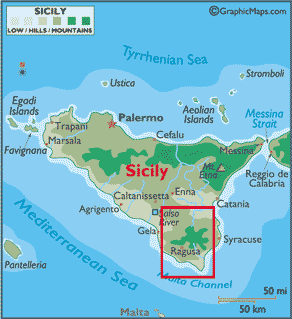
Click on highlighted area
for details of SE Sicily
Caltagirone is one of Sicily's oldest towns,
having been settled centuries before Greek colonisation. Nothing however
remains from this early period since the fateful year of 1693 dealt
south-eastern Sicily a devastating blow: a catastrophic earthquake (terramoto
in Italian) killed over 60,000 people and totally destroyed every town.
Rebuilding was carried out in the characteristically ornate Baroque
style of the early 18th century.
Caltagirone developed the reputation for quality ceramics, skills learnt
from Arab craftsmen who introduced the highly glazed, polychromatic
designs now typical of Sicilian ceramic ware. Post-earthquake
rebuilding gave further boost to Caltagirone's ceramics industry, still
seen in the town today with colourful tiling decorating both major
buildings and tiny nooks and crannies around the town and streets lined
with workshops and galleries. But the grandest statement of ceramic
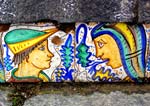
skills is Caltagirone's Scala, a 142 step staircase linking the upper
and lower town, with the risers between steps decorated with Majolica
tiles hand-painted with pictorial and patterned designs (Photo 1).
From the top, the view across the town's grand buildings was
magnificent.
We moved
on to Grammichele, another of the towns which arose from the ruins of
the 1693 earthquake. The forerunner settlement of Occhiola was rebuilt
as a model new town to a novel design planned around a hexagonal central
piazza with 6 roads radiating out like spokes and outer rings of concentric
streets encircling the town. Grammichele still preserves this unique
design almost intact.
The huge hexagonal central piazza was in process of renovation, giving
this grand urban space an air of dereliction; but this did not prevent
the town's elderly gents taking their evening passegiata and
gathering in groups to socialise. Grammichele's small Archaeological
Museum is worth a visit for its displays of local remains ranging from
ancient Sikel settlements through to relics recovered from the 1693
disaster. It was late in the day and we needed somewhere to camp; the
only place in Grammichele we could find was the car park outside the
town's cemetery at what must be the most bizarre wild-camp spot ever.
The neighbours were certainly quiet, but early next morning, locals
began arriving for the first funeral of the day. It was a tragi-comical
scene, being camped doing the washing-up in the midst of a funeral
gathering. But such is Sicilian relaxed manner that no one seemed to
mind and one kindly gent even showed us a tap for water.
Further
south, we reached Ragusa, a large town set on a high plateau of the
Monti Iblei hills. The old town of Ragusa Ibla, sited on a limestone
spur projecting above steep-sided valleys, was totally flattened by the
1693 earthquake,
but within a few years, the new town of Ragusa was built higher up
the ridge surrounded by precipitous valleys. The modern city has
developed across this craggy ridge, separated from the medieval
town of Ragusa Ibla rebuilt on the original location. The 2 rival towns
re-united in 1926, but with Ragusa's rapidly developing commercial
success, Ibla fell into decline, only recently tidied up at EU expense
as tourist centre. The steps edging down from Ragusa give majestic views
over the blue Majolica-domed church of Santa Maria dell' Idria and the
pan-tiled roofs across to the older town of Ibla with its restored
buildings clustered around the hilltop crowned by the dome of the Duomo (Photo 2). Ragusa
Ibla's flamboyant cathedral is one of the
masterpieces of Sicilian Baroque, designed by the leading 18th century
architect, Rosario Gagliardi, who did very nicely thank you rebuilding
the cathedrals of SE Sicily in the aftermath of 1693 with his standard
designs: you could have anything you like so long as the façade had 3
tiers, sets of triple columns surmounting a wedding-cake exterior to a
balconied belfry, with a convex-rounded curvature - take it or leave it
and live with the pile of debris of your old cathedral wrecked by the
earthquake. Despite gloomy weather, we spent a happy afternoon ambling
around Ragusa Ibla before heading down to the southern coast, looking
forward to a comfortable campsite at Marina di Ragusa after 3 nights of
wild-camping. Having watched the village band tuning up for a funeral
(today was a popular time to be buried in Sicily), we drove with great
expectations to the campsite, only to find the gate locked and the
dreaded sign 'chiuso'. And the rain poured down. We had no option but to
turn westwards along the coast to find other campsite options at Punto
Braccetto near San Croce Camerina. At the end of the road, we found the
most hospitable welcome ever at the newly modernised Campeggio Scarabeo.
The site was beautifully landscaped with tropical trees and shrubs and
sheltered from the brisk SW breeze by bamboo screens, with salt spray
from the surf which crashed onto a glorious golden beach.
We could
not have asked for a better spot to rest up for the Easter weekend, and
the sky cleared to give a perfect sunset across the sea (Photo 3).
With such a setting, hospitable welcome and good value at €17 a night
(remember to ask for a sconto/discount), Scarabeo had to merit the
accolade as campsite of the trip. Nothing was too much trouble for
the owner, Angela di Modica. A problem with our camper needed
VW attention: Angela phoned the VW garage in Ragusa fixing us an
appointment on Good Friday morning. The problem was sorted, and the
manager at VW Belluardo insisted there would be no charge. We have
enjoyed so much helpfulness in Sicily. Much relieved we were able to get
to the town of Vittoria in time for the traditional Good Friday procession.
Crowds gathered in the central piazza, and at noon the procession
emerged from the church, with local dignitaries bearing a bier with a
wooden figure of the crucified Christ covered with a purple shroud. The
band played mournfully funereal music, and people rushed forward to
touch the bier. The whole aura and setting was so moving, almost evoking
tears. Leaders of the procession carried wooden rattles, and the sound
of these echoing around the streets was chillingly pagan, a throw back
to some pre-Christian ritual to scare off evil from the holy object. And
bringing up the rear was a huge figure of Maria, Madre Dolorosa mounted
aloft on a cart decorated with flowers, her heart pierced by a dagger
symbolising her sorrow at the crucifixion (Photo 3). We joined the crowds
following the procession; in the past, it was absolutely de rigeur for
women to be veiled and dressed entirely in black with total silence
observed as befits a solemn funeral. Today was more of a carnival
atmosphere with balloons and jollity; women dressed fashionably and men
looking uncomfortable in their Sunday suits. Good Friday in Vittoria was
another occasion when we felt privileged to be sharing in a local
festival, albeit more secular in tone nowadays than its religious
origins suggested.
Later that
afternoon, we drove down to the coast to visit the archaeological site
of the ancient Greek colony
of
Camerina. It was evocative simply for the sense of awareness of this
once thriving city, its streets, houses and temples; all that remains
now is an open hillside of bright yellow and purple wild flowers,
dotted with the occasional dwarf palm, and set above an aquamarine sea
sparkling in the beautiful sunshine. It was a glorious setting, and back
at camp that evening we were rewarded with another flaring sunset across
the bay.
We spent
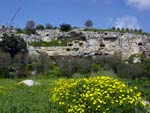
Easter Saturday visiting the gorge of Cava d'Ispica, carved out of the
limestone plateau of Monti Iblei by an ancient river. The rocky walls of
the gorge carry traces of 3,500 years of life and death, with
prehistoric necropolis, early Christian catacombs (Photo 5)and
medieval cave dwellings, all cut into the rock. All of this was brought
to an end by the 1693 cataclysmic earthquake when the site was
abandoned. And today the floor of the gorge is filled with a paradise
garden of bright wild flora, prickly pears and dwarf palms.
Easter
Sunday in Sicilian towns is a time for traditional festivities
celebrating the Resurrection. We joined the crowds, who greeted friends
with kisses and 'Buona Pasqua', in the town of Scicli, another victim of
the 1693 earthquake rebuilt in flamboyant Baroque. All we knew was that
a decorated statue representing the Risen Christ would be raced triumphantly
through the streets. We waited with the surging crowds at the church of
Santa Maria la Nuova, peering into the dark interior from where
riotously irreverent cheers and excitement could be heard. At 1-00pm,
the crowds were pushed back with much shouting and shoving; to cheers
and applause, the local 'lads' hurtled the enormous statue out of the
church's interior darkness into the light of day; it was a bizarre
mix of symbolic reverence and utterly pagan Carnivale. The heavy wooden
bier was hurled around and the statue up aloft twisted and danced at
crazy angles as the scrummage underneath whirled the bier around at a
furious pace. Amid this riotous melée,
the crowds backed away in fear of being overwhelmed by the massed weight
of bier and surging hefty bodies. The statue was surged forward down the
church steps as spectators from the balconies overhead showered confetti
(Photo 6) and cracking detonations of fireworks echoed around the
craggy limestone cliffs which surrounded the town. Whatever its symbolic
religious origins, today's celebrations abounded in secular festivities;
it was utterly mesmerising and delightful bedlam, and amid the happy
revelry, we glanced upwards at the magnificent Baroque churches and
palazzi which line the streets of Scicli.
After a
night's camp at a wholly unworthy and run-down dump which passed for a
campsite (shall we name and shame? - yes, it was called Il Forte, and
should be avoided) near the
tiny
fishing village of Marzameni, we
celebrated Easter Monday with a visit to Sicily's southernmost point,
Capo Passero (Photo
7); on a clear day, you felt the North African coast should have
been visible. Turning up the eastern coastline, we headed for the Riserva Naturale di Vendicari, a protected area of coastal meres and
coastline where the air was filled with the sweet scent of orange
blossom from surrounding citrus groves. From a hide near one of the
lagoons, we saw spoonbills performing their peculiar feeding ritual, a
large flock of flamingos showing their pink wing tips, black-winged
stilts with their long spindly red legs, white and grey heron and
egrets. The sun was pleasantly warm and the air clear and fresh as we
walked along the rocky shoreline, enjoying the peaceful afternoon and
flourishing wild flora. That night we stayed at Sabbiadoro Camping near
to Avola, a glorious setting with terraces overlooking a turquoise sea,
and shaded with cycads and cactus.
We visited
our final 'earthquake' town, Noto, by local bus, a hit and miss journey
with all the uncertainties of Sicilian bus timetables. The former
settlement of Noto Antica was totally destroyed in the 1693 cataclysm;
rebuilding on a fresh site 16 kms to the south began soon after with a
grandly prestigious plan for a model new town. The local population was
less impressed and reconstructed a shanty town amid the ruins of their
former homes. Long before the days of compulsory
purchase orders, the
new town's architects reinforced the move to Noto. With the accent on
symmetry and visual harmony, Noto was aesthetically the most successful
of the new post-1693 towns of SE Sicily. But it was doomed to
disaster: the local Iblea soft chalky limestone, so workable for
delicate carvings, is also highly friable. Years of neglect and belated
reconstruction work, delayed by interminable Italian bureaucracy,
culminated in the collapse of the Duomo's dome in 1996; although the
dome has at last been restored, the cathedral has been shrouded in
scaffolding ever since along with many of Noto's other grand buildings.
In bright sunshine, the stonework of Noto's buildings glowed a golden honey
colour. Somehow symbolising Noto's fate, tower cranes and scaffolding
will mingle with the glorious Baroque for years to come. The following
day, we ventured up into the Monti Iblei to visit the site of Noto's
predecessor, Noto Antica. But be warned, the road is scarily narrow;
unless you drive a small VW camper, don't even attempt it. The scant
remains of the former town set high on the ridge of Monte Alveria, and
destroyed by the 1693 earthquake, are now totally overgrown, but the
atmosphere and setting are so evocative and the wild flora simply
stunning.
The SE corner of Sicily has been a rewarding
period. Our continuing journey will take us northwards, so join us again
next week for a 'walk with Thucydides' around the scene of the Athenian
Great Expedition's tragic and humiliating defeat at Syracuse, and
onwards from there to Sicily's second city, Catania. Arrivederci.


 Caltagirone developed the reputation for quality ceramics, skills learnt
from Arab craftsmen who introduced the highly glazed, polychromatic
designs now typical of Sicilian ceramic ware. Post-earthquake
rebuilding gave further boost to Caltagirone's ceramics industry, still
seen in the town today with colourful tiling decorating both major
buildings and tiny nooks and crannies around the town and streets lined
with workshops and galleries. But the grandest statement of ceramic
skills is Caltagirone's Scala, a 142 step staircase linking the upper
and lower town, with the risers between steps decorated with Majolica
tiles hand-painted with pictorial and patterned designs (Photo 1).
From the top, the view across the town's grand buildings was
magnificent.
Caltagirone developed the reputation for quality ceramics, skills learnt
from Arab craftsmen who introduced the highly glazed, polychromatic
designs now typical of Sicilian ceramic ware. Post-earthquake
rebuilding gave further boost to Caltagirone's ceramics industry, still
seen in the town today with colourful tiling decorating both major
buildings and tiny nooks and crannies around the town and streets lined
with workshops and galleries. But the grandest statement of ceramic
skills is Caltagirone's Scala, a 142 step staircase linking the upper
and lower town, with the risers between steps decorated with Majolica
tiles hand-painted with pictorial and patterned designs (Photo 1).
From the top, the view across the town's grand buildings was
magnificent.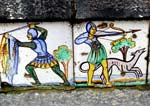 We moved
on to Grammichele, another of the towns which arose from the ruins of
the 1693 earthquake. The forerunner settlement of Occhiola was rebuilt
as a model new town to a novel design planned around a hexagonal central
piazza with 6 roads radiating out like spokes and outer rings of concentric
streets encircling the town. Grammichele still preserves this unique
design almost intact.
The huge hexagonal central piazza was in process of renovation, giving
this grand urban space an air of dereliction; but this did not prevent
the town's elderly gents taking their evening passegiata and
gathering in groups to socialise. Grammichele's small Archaeological
Museum is worth a visit for its displays of local remains ranging from
ancient Sikel settlements through to relics recovered from the 1693
disaster. It was late in the day and we needed somewhere to camp; the
only place in Grammichele we could find was the car park outside the
town's cemetery at what must be the most bizarre wild-camp spot ever.
The neighbours were certainly quiet, but early next morning, locals
began arriving for the first funeral of the day. It was a tragi-comical
scene, being camped doing the washing-up in the midst of a funeral
gathering. But such is Sicilian relaxed manner that no one seemed to
mind and one kindly gent even showed us a tap for water.
We moved
on to Grammichele, another of the towns which arose from the ruins of
the 1693 earthquake. The forerunner settlement of Occhiola was rebuilt
as a model new town to a novel design planned around a hexagonal central
piazza with 6 roads radiating out like spokes and outer rings of concentric
streets encircling the town. Grammichele still preserves this unique
design almost intact.
The huge hexagonal central piazza was in process of renovation, giving
this grand urban space an air of dereliction; but this did not prevent
the town's elderly gents taking their evening passegiata and
gathering in groups to socialise. Grammichele's small Archaeological
Museum is worth a visit for its displays of local remains ranging from
ancient Sikel settlements through to relics recovered from the 1693
disaster. It was late in the day and we needed somewhere to camp; the
only place in Grammichele we could find was the car park outside the
town's cemetery at what must be the most bizarre wild-camp spot ever.
The neighbours were certainly quiet, but early next morning, locals
began arriving for the first funeral of the day. It was a tragi-comical
scene, being camped doing the washing-up in the midst of a funeral
gathering. But such is Sicilian relaxed manner that no one seemed to
mind and one kindly gent even showed us a tap for water.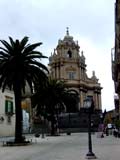 Further
south, we reached Ragusa, a large town set on a high plateau of the
Monti Iblei hills. The old town of Ragusa Ibla, sited on a limestone
spur projecting above steep-sided valleys, was totally flattened by the
1693 earthquake,
but within a few years, the new town of Ragusa was built higher up
the ridge surrounded by precipitous valleys. The modern city has
developed across this craggy ridge, separated from the medieval
town of Ragusa Ibla rebuilt on the original location. The 2 rival towns
re-united in 1926, but with Ragusa's rapidly developing commercial
success, Ibla fell into decline, only recently tidied up at EU expense
as tourist centre. The steps edging down from Ragusa give majestic views
over the blue Majolica-domed church of Santa Maria dell' Idria and the
pan-tiled roofs across to the older town of Ibla with its restored
buildings clustered around the hilltop crowned by the dome of the Duomo (Photo 2). Ragusa
Ibla's flamboyant cathedral is one of the
masterpieces of Sicilian Baroque, designed by the leading 18th century
architect, Rosario Gagliardi, who did very nicely thank you rebuilding
the cathedrals of SE Sicily in the aftermath of 1693 with his standard
designs: you could have anything you like so long as the façade had 3
tiers, sets of triple columns surmounting a wedding-cake exterior to a
balconied belfry, with a convex-rounded curvature - take it or leave it
and live with the pile of debris of your old cathedral wrecked by the
earthquake. Despite gloomy weather, we spent a happy afternoon ambling
around Ragusa Ibla before heading down to the southern coast, looking
forward to a comfortable campsite at Marina di Ragusa after 3 nights of
wild-camping. Having watched the village band tuning up for a funeral
(today was a popular time to be buried in Sicily), we drove with great
expectations to the campsite, only to find the gate locked and the
dreaded sign 'chiuso'. And the rain poured down. We had no option but to
turn westwards along the coast to find other campsite options at Punto
Braccetto near San Croce Camerina. At the end of the road, we found the
most hospitable welcome ever at the newly modernised Campeggio Scarabeo.
The site was beautifully landscaped with tropical trees and shrubs and
sheltered from the brisk SW breeze by bamboo screens, with salt spray
from the surf which crashed onto a glorious golden beach.
Further
south, we reached Ragusa, a large town set on a high plateau of the
Monti Iblei hills. The old town of Ragusa Ibla, sited on a limestone
spur projecting above steep-sided valleys, was totally flattened by the
1693 earthquake,
but within a few years, the new town of Ragusa was built higher up
the ridge surrounded by precipitous valleys. The modern city has
developed across this craggy ridge, separated from the medieval
town of Ragusa Ibla rebuilt on the original location. The 2 rival towns
re-united in 1926, but with Ragusa's rapidly developing commercial
success, Ibla fell into decline, only recently tidied up at EU expense
as tourist centre. The steps edging down from Ragusa give majestic views
over the blue Majolica-domed church of Santa Maria dell' Idria and the
pan-tiled roofs across to the older town of Ibla with its restored
buildings clustered around the hilltop crowned by the dome of the Duomo (Photo 2). Ragusa
Ibla's flamboyant cathedral is one of the
masterpieces of Sicilian Baroque, designed by the leading 18th century
architect, Rosario Gagliardi, who did very nicely thank you rebuilding
the cathedrals of SE Sicily in the aftermath of 1693 with his standard
designs: you could have anything you like so long as the façade had 3
tiers, sets of triple columns surmounting a wedding-cake exterior to a
balconied belfry, with a convex-rounded curvature - take it or leave it
and live with the pile of debris of your old cathedral wrecked by the
earthquake. Despite gloomy weather, we spent a happy afternoon ambling
around Ragusa Ibla before heading down to the southern coast, looking
forward to a comfortable campsite at Marina di Ragusa after 3 nights of
wild-camping. Having watched the village band tuning up for a funeral
(today was a popular time to be buried in Sicily), we drove with great
expectations to the campsite, only to find the gate locked and the
dreaded sign 'chiuso'. And the rain poured down. We had no option but to
turn westwards along the coast to find other campsite options at Punto
Braccetto near San Croce Camerina. At the end of the road, we found the
most hospitable welcome ever at the newly modernised Campeggio Scarabeo.
The site was beautifully landscaped with tropical trees and shrubs and
sheltered from the brisk SW breeze by bamboo screens, with salt spray
from the surf which crashed onto a glorious golden beach.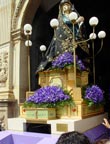 We could
not have asked for a better spot to rest up for the Easter weekend, and
the sky cleared to give a perfect sunset across the sea (Photo 3).
With such a setting, hospitable welcome and good value at €17 a night
(remember to ask for a sconto/discount), Scarabeo had to merit the
accolade as campsite of the trip. Nothing was too much trouble for
the owner, Angela di Modica. A problem with our camper needed
VW attention: Angela phoned the VW garage in Ragusa fixing us an
appointment on Good Friday morning. The problem was sorted, and the
manager at VW Belluardo insisted there would be no charge. We have
enjoyed so much helpfulness in Sicily. Much relieved we were able to get
to the town of Vittoria in time for the traditional Good Friday procession.
Crowds gathered in the central piazza, and at noon the procession
emerged from the church, with local dignitaries bearing a bier with a
wooden figure of the crucified Christ covered with a purple shroud. The
band played mournfully funereal music, and people rushed forward to
touch the bier. The whole aura and setting was so moving, almost evoking
tears. Leaders of the procession carried wooden rattles, and the sound
of these echoing around the streets was chillingly pagan, a throw back
to some pre-Christian ritual to scare off evil from the holy object. And
bringing up the rear was a huge figure of Maria, Madre Dolorosa mounted
aloft on a cart decorated with flowers, her heart pierced by a dagger
symbolising her sorrow at the crucifixion (Photo 3). We joined the crowds
following the procession; in the past, it was absolutely de rigeur for
women to be veiled and dressed entirely in black with total silence
observed as befits a solemn funeral. Today was more of a carnival
atmosphere with balloons and jollity; women dressed fashionably and men
looking uncomfortable in their Sunday suits. Good Friday in Vittoria was
another occasion when we felt privileged to be sharing in a local
festival, albeit more secular in tone nowadays than its religious
origins suggested.
We could
not have asked for a better spot to rest up for the Easter weekend, and
the sky cleared to give a perfect sunset across the sea (Photo 3).
With such a setting, hospitable welcome and good value at €17 a night
(remember to ask for a sconto/discount), Scarabeo had to merit the
accolade as campsite of the trip. Nothing was too much trouble for
the owner, Angela di Modica. A problem with our camper needed
VW attention: Angela phoned the VW garage in Ragusa fixing us an
appointment on Good Friday morning. The problem was sorted, and the
manager at VW Belluardo insisted there would be no charge. We have
enjoyed so much helpfulness in Sicily. Much relieved we were able to get
to the town of Vittoria in time for the traditional Good Friday procession.
Crowds gathered in the central piazza, and at noon the procession
emerged from the church, with local dignitaries bearing a bier with a
wooden figure of the crucified Christ covered with a purple shroud. The
band played mournfully funereal music, and people rushed forward to
touch the bier. The whole aura and setting was so moving, almost evoking
tears. Leaders of the procession carried wooden rattles, and the sound
of these echoing around the streets was chillingly pagan, a throw back
to some pre-Christian ritual to scare off evil from the holy object. And
bringing up the rear was a huge figure of Maria, Madre Dolorosa mounted
aloft on a cart decorated with flowers, her heart pierced by a dagger
symbolising her sorrow at the crucifixion (Photo 3). We joined the crowds
following the procession; in the past, it was absolutely de rigeur for
women to be veiled and dressed entirely in black with total silence
observed as befits a solemn funeral. Today was more of a carnival
atmosphere with balloons and jollity; women dressed fashionably and men
looking uncomfortable in their Sunday suits. Good Friday in Vittoria was
another occasion when we felt privileged to be sharing in a local
festival, albeit more secular in tone nowadays than its religious
origins suggested.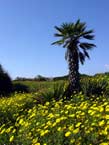 Later that
afternoon, we drove down to the coast to visit the archaeological site
of the ancient Greek colony
of
Camerina. It was evocative simply for the sense of awareness of this
once thriving city, its streets, houses and temples; all that remains
now is an open hillside of bright yellow and purple wild flowers,
Later that
afternoon, we drove down to the coast to visit the archaeological site
of the ancient Greek colony
of
Camerina. It was evocative simply for the sense of awareness of this
once thriving city, its streets, houses and temples; all that remains
now is an open hillside of bright yellow and purple wild flowers,
 dotted with the occasional dwarf palm, and set above an aquamarine sea
sparkling in the beautiful sunshine. It was a glorious setting, and back
at camp that evening we were rewarded with another flaring sunset across
the bay.
dotted with the occasional dwarf palm, and set above an aquamarine sea
sparkling in the beautiful sunshine. It was a glorious setting, and back
at camp that evening we were rewarded with another flaring sunset across
the bay.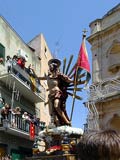 Christ would be raced triumphantly
through the streets. We waited with the surging crowds at the church of
Santa Maria la Nuova, peering into the dark interior from where
riotously irreverent cheers and excitement could be heard. At 1-00pm,
the crowds were pushed back with much shouting and shoving; to cheers
and applause, the local 'lads' hurtled the enormous statue out of the
church's interior darkness into the light of day; it was a bizarre
mix of symbolic reverence and utterly pagan Carnivale. The heavy wooden
bier was hurled around and the statue up aloft twisted and danced at
crazy angles as the scrummage underneath whirled the bier around at a
furious pace. Amid this riotous melée,
the crowds backed away in fear of being overwhelmed by the massed weight
of bier and surging hefty bodies. The statue was surged forward down the
church steps as spectators from the balconies overhead showered confetti
(Photo 6) and cracking detonations of fireworks echoed around the
craggy limestone cliffs which surrounded the town. Whatever its symbolic
religious origins, today's celebrations abounded in secular festivities;
it was utterly mesmerising and delightful bedlam, and amid the happy
revelry, we glanced upwards at the magnificent Baroque churches and
palazzi which line the streets of Scicli.
Christ would be raced triumphantly
through the streets. We waited with the surging crowds at the church of
Santa Maria la Nuova, peering into the dark interior from where
riotously irreverent cheers and excitement could be heard. At 1-00pm,
the crowds were pushed back with much shouting and shoving; to cheers
and applause, the local 'lads' hurtled the enormous statue out of the
church's interior darkness into the light of day; it was a bizarre
mix of symbolic reverence and utterly pagan Carnivale. The heavy wooden
bier was hurled around and the statue up aloft twisted and danced at
crazy angles as the scrummage underneath whirled the bier around at a
furious pace. Amid this riotous melée,
the crowds backed away in fear of being overwhelmed by the massed weight
of bier and surging hefty bodies. The statue was surged forward down the
church steps as spectators from the balconies overhead showered confetti
(Photo 6) and cracking detonations of fireworks echoed around the
craggy limestone cliffs which surrounded the town. Whatever its symbolic
religious origins, today's celebrations abounded in secular festivities;
it was utterly mesmerising and delightful bedlam, and amid the happy
revelry, we glanced upwards at the magnificent Baroque churches and
palazzi which line the streets of Scicli. After a
night's camp at a wholly unworthy and run-down dump which passed for a
campsite (shall we name and shame? - yes, it was called Il Forte, and
should be avoided) near the
tiny
fishing village of Marzameni, we
celebrated Easter Monday with a visit to Sicily's southernmost point,
Capo Passero (Photo
7); on a clear day, you felt the North African coast should have
been visible. Turning up the eastern coastline, we headed for the
After a
night's camp at a wholly unworthy and run-down dump which passed for a
campsite (shall we name and shame? - yes, it was called Il Forte, and
should be avoided) near the
tiny
fishing village of Marzameni, we
celebrated Easter Monday with a visit to Sicily's southernmost point,
Capo Passero (Photo
7); on a clear day, you felt the North African coast should have
been visible. Turning up the eastern coastline, we headed for the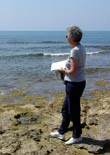 Riserva Naturale di Vendicari, a protected area of coastal meres and
coastline where the air was filled with the sweet scent of orange
blossom from surrounding citrus groves. From a hide near one of the
lagoons, we saw spoonbills performing their peculiar feeding ritual, a
large flock of flamingos showing their pink wing tips, black-winged
stilts with their long spindly red legs, white and grey heron and
egrets. The sun was pleasantly warm and the air clear and fresh as we
walked along the rocky shoreline, enjoying the peaceful afternoon and
flourishing wild flora. That night we stayed at Sabbiadoro Camping near
to Avola, a glorious setting with terraces overlooking a turquoise sea,
and shaded with cycads and cactus.
Riserva Naturale di Vendicari, a protected area of coastal meres and
coastline where the air was filled with the sweet scent of orange
blossom from surrounding citrus groves. From a hide near one of the
lagoons, we saw spoonbills performing their peculiar feeding ritual, a
large flock of flamingos showing their pink wing tips, black-winged
stilts with their long spindly red legs, white and grey heron and
egrets. The sun was pleasantly warm and the air clear and fresh as we
walked along the rocky shoreline, enjoying the peaceful afternoon and
flourishing wild flora. That night we stayed at Sabbiadoro Camping near
to Avola, a glorious setting with terraces overlooking a turquoise sea,
and shaded with cycads and cactus.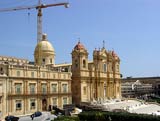 purchase orders, the
new town's architects reinforced the move to Noto. With the accent on
symmetry and visual harmony, Noto was aesthetically the most successful
of the new post-1693 towns of SE Sicily. But it was doomed to
disaster: the local Iblea soft chalky limestone, so workable for
delicate carvings, is also highly friable. Years of neglect and belated
reconstruction work, delayed by interminable Italian bureaucracy,
purchase orders, the
new town's architects reinforced the move to Noto. With the accent on
symmetry and visual harmony, Noto was aesthetically the most successful
of the new post-1693 towns of SE Sicily. But it was doomed to
disaster: the local Iblea soft chalky limestone, so workable for
delicate carvings, is also highly friable. Years of neglect and belated
reconstruction work, delayed by interminable Italian bureaucracy,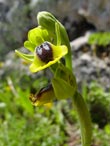 culminated in the collapse of the Duomo's dome in 1996; although the
dome has at last been restored, the cathedral has been shrouded in
scaffolding ever since along with many of Noto's other grand buildings.
In bright sunshine, the stonework of Noto's buildings glowed a golden honey
colour. Somehow symbolising Noto's fate, tower cranes and scaffolding
will mingle with the glorious Baroque for years to come. The following
day, we ventured up into the Monti Iblei to visit the site of Noto's
predecessor, Noto Antica. But be warned, the road is scarily narrow;
unless you drive a small VW camper, don't even attempt it. The scant
remains of the former town set high on the ridge of Monte Alveria, and
destroyed by the 1693 earthquake, are now totally overgrown, but the
atmosphere and setting are so evocative and the wild flora simply
stunning.
culminated in the collapse of the Duomo's dome in 1996; although the
dome has at last been restored, the cathedral has been shrouded in
scaffolding ever since along with many of Noto's other grand buildings.
In bright sunshine, the stonework of Noto's buildings glowed a golden honey
colour. Somehow symbolising Noto's fate, tower cranes and scaffolding
will mingle with the glorious Baroque for years to come. The following
day, we ventured up into the Monti Iblei to visit the site of Noto's
predecessor, Noto Antica. But be warned, the road is scarily narrow;
unless you drive a small VW camper, don't even attempt it. The scant
remains of the former town set high on the ridge of Monte Alveria, and
destroyed by the 1693 earthquake, are now totally overgrown, but the
atmosphere and setting are so evocative and the wild flora simply
stunning.