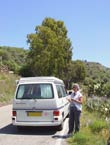
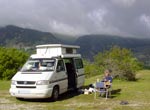
Our one night
stay at Camping Cirucco near to Cape Milazzo was buoyed with excitement
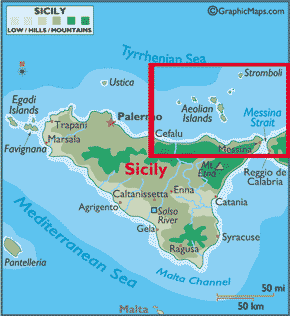
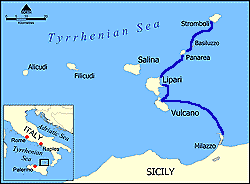
and expectation: tomorrow we were to catch the ferry out to the volcanic
Aeolian Islands - Lipari, Vulcano, Salina and Panarea 20 miles out into
the Tyrrhenian Sea north of Sicily, and the still active Stromboli a
further 20 miles out. In the port of Milazzo that afternoon, we had
managed to garner information about ferry sailing times: there are 3
ferry operators - Siremar and NGI ferries (navi) carry
vehicles, and Ustica Lines operate the faster passenger-only
hydrofoils (aliscarfi).
Click on highlighted area
for details of Aeolian Islands
But despite all our efforts and an early start, a
crushing disappointment faced us when we reached
the port: sailings
today were cancelled because of bad weather. Even in harbour, the sea
was whipped into foaming frenzy by the harshly gusting warm Sirocco wind, blowing directly from the Sahara and depositing
layers of sand on
cars in the port. The Siremar ticket-office staff have perfected the art-form of
being officiously unhelpful and non-communicative: next sailing? who
knows ... shrug. As instructed, we returned later, 20 minutes
before the next sailing to find a milling hoard of expectant passengers
besieging the ferry office: only the most determined of Sicilians got
served in this mêlée, but we did manage to secure tickets for the 6-30
pm sailing out to Lipari. After all this bewildering comedy,
we eventually boarded the ferry for the evening crossing, and were rewarded with a
magnificent sunset silhouetting the nearest island of Vulcano, its
volcanic cone rising steeply out of the sea (Photo 1). A further
20 minutes brought us to Lipari which we had planned to make our base for
the next week's exploration of the Aeolian Islands, named after Aeolus,
the mythical King of the Winds which had delayed our departure that
morning.
Lipari, the largest of the
Islands, has an amazing array of natural scenery to be explored, with
spectacular views across the aquamarine sea to neighbouring islands. Along the north
coast, natural resources of
volcanic
origin have
been extracted since antiquity: obsidian (volcanic natural glass),
sharper than flint, was worked into tools and weapons by Neolithic craftsmen bringing
prosperity to these early settlers; today the coastline is scarred by
the dazzling white waste from pumice quarries, a natural volcanic
material used in modern chemical and pharmaceutical industries. Among
the pumice waste, we were able still to find sherds of shiny black
obsidian. And along the flora-covered cliff tops of the southern
coastline, a magnificent panorama opened up towards the nearby island of Vulcano (Photo 2).
In addition to these
natural wonders, the Aeolian Islands house one of Europe's most important
prehistoric and Classical collections of remains from Neolithic and
Greco-Roman settlements on the islands. The
Museo Eoliano at the citadel in Lipari town displays archaeological
finds preserved in layers of fine volcanic ash and illustrating the
succession of cultures which flourished on the Aeolians from the 1st
human settlements in the Neolithic period through the Bronze Age to the
arrival of Greek colonists in the 6~5th centuries BC. Such was the
economic importance of obsidian working before the discovery of metal
smelting technology that remains show trading contacts between the
Aeolian Islands and Mycenaean Greece. Lipari continued as a flourishing
strategic centre during the Greek and Roman periods. Whether ancient
history is your thing or not, the museum is well worth a visit, showing
a comprehensive coverage of several millennia of local Aeolian history.
Lipari has only 1
campsite, Baia Unci Camping; despite being well-placed at the beach-side
village of Canneto 3 kms from the port with regular bus service to other
parts of the island, there any favourable report ends. When a campsite
greets its guests with a diktat-list of rules forbidding everything,
particularly enjoying a
relaxed
and peaceful stay, alarm bells should ring. Officiously unwelcoming staff displayed an
inhospitable attitude and arrogant disregard for the well-being of
regular camping clientele. Baia Unci has discovered the
lucrative school party trade: the site was invaded by hoards of
screaming teenagers who were allowed to rampage around making
insufferable noise until midnight. Such were the indefensible dual
standards that regular campers were subjected to pettifogging
regulation, while in laissez-faire contrast, school parties were allowed
to run amok unchecked. After 2 days, enough was enough and we left glad
to shake the volcanic dust of Baia Unci from our feet. In 40 years of
camping, Baia Unci on Lipari was the worst campsite we have ever
experienced. Fortunately there is an alternative campsite on
the neighbouring island of Vulcano which showed a marked contrast in
attitude towards its guests. We found Togo Togo
Camping on Vulcano a pleasantly straightforward site, shaded by scented eucalyptus
trees and looking across a beach of black volcanic sand to the smoking
cone of Vulcano's Grand Crater. It was a glorious setting, but more
importantly, we were welcomed with warm hospitality by the
family; Togo Togo Camping on Vulcano is thoroughly recommended for its
setting and its relaxed and welcoming atmosphere.
From this delightful base,
we continued our exploration of the Aeolian Islands. Vulcano itself is
dominated by the brooding cone of its Grand Crater. Although inactive
since its last eruption in 1890, this
dormant volcano still exhibits spectacular but menacing secondary
volcanic activity in the form of sulphur-encrusted steaming fumaroles
around the crater rim. The beast is now constantly monitored for any
signs of resurgent activity. It's a gruelling
1,350 feet slog up the ash
cone of Vulcano's Grand Crater, and we paused for lunch at one of the
more bizarre spots of our travels (Photo 3). The sight however to
greet you at the rim
defies description: the crater is 650 feet deep and 6,500 feet across,
and the northern
flank is lined with a series of fumaroles (Photo 4),
bright yellow with sulphur deposits and gushing pungent smoke and steam.
And the immediate sight from this uncertain vantage point was offset by
the distant views of Lipari and Salina across the azure-blue straits. We
walked the crater's circuit to tread gingerly over the hot steaming
ground; the fumaroles are encrusted with beautiful sulphur crystals, the
air reeking of choking sulphurous gases (Photos 5 and 6). It was
like gazing on a sci-fi film set and truly one of the most memorable
experiences of our travels, and that evening from the campsite, we sat
eating supper looking directly up at the steaming volcanic cone.
The climax to our time in
the Aeolians was to be a visit to Stromboli, the most distant of the
islands its volcanic peak being in a constant state of eruption. Our
enquiries showed the most practicable transport was to take
one of the
many long-day privately operated excursions which return late evening
allowing sight of the glowing volcanic material ejected from the island's
crater and rolling down to the sea. Although expensive, the private boats work out the same cost as
the limited hydrofoil service which would need a costly overnight stay
on Stromboli. When we came to book however, we learned to our bitter
disappointment that,
since vigorous eruptions in February this year, Stromboli had been
uncharacteristically quiescent, emitting not the usual spectacular lava
fireworks, but merely dangerous volcanic gases. As a result, not only
would there be no explosive volcanic activity to witness at close
quarters but the whole summit area was now 'out of bounds'. Even the
more restricted guided climbs were already fully booked. We had therefore to
settle for a more limited experience and hoped that we could at least
sample Stromboli. The boat sped out across the open channel, approaching
firstly Panarea whose sheer volcanic cliffs loomed ever closer.
Frustratingly, undue time was allocated here, and although Panarea is a
beautiful island, we were anxious to reach Stromboli. The views however
from the southern cape, with the panorama of Lipari, Vulcano and Salina
spread along the horizon, were spectacular (Photo 7).
At 3-30 we
were at last on our way to Stromboli, and as we approached, the island
looked fearsome with its cone capped by volcanic cloud. Rounding the
craggy western side, there ahead was the mighty Sciara del Fuoco (Slope
of Fire) down which incandescent lava from the volcano normally spills.
But
today, with the volcano not erupting, there was no trace of glowing
lava, just the barren grey slopes of volcanic debris (see left for the
Sciara's normal fiery appearance, and right for our experience). From
the seaward northern side, the panorama of Stromboli was a formidable
sight with the afternoon sun illuminating clouds of volcanic gases
billowing down steep gullies from the crater (Photo 8). Our time
ashore was limited, allowing opportunity only to walk out towards the
observatory above the Sciara del Fuoco across the barren black landscape
which contrasted starkly with the island's white cottages. It was a
brief and frustrating visit with little to see of the volcano in its
uncharacteristically quiescent state. But at least we had witnessed
unsurpassed views from the sea. Despite our disappointment, emergency
evacuation signs pointing to muster points in the event of eruptions
showed that Stromboli does pose a serious threat to the islanders. We were unlucky with timing of our visit to Stromboli, but to give an impression of what we had hoped to experience, included
try this link for
'a virtual climb'
of Stromboli
Despite adverse winds and
unpredictable ferries, we eventually arrived back at Milazzo on the
Sicilian 'mainland', and as we approached the port at dusk, 2 porpoises
passed by arching out of the sea. Our final week would be spent along
the north coast. Compared however with our time elsewhere in Sicily,
this was something of an anticlimax. The mountainous hinterland dropped
steeply down to a narrow coastal strip along which motorway, railway and
main road competed for space and which was populated with a series of
unattractive and eminently forgettable resorts. This
was the least appealing part of Sicily we had seen. Even worse however
were some of the surly attitudes we encountered both on the Aeolians and
along the north coast. Their economy is totally dependent on tourism,
but they resent visitors, and show it - we want your money but not you.
This was such a stark contrast with the helpful and hospitable welcome
we had universally received in other parts of the country. Our
conclusion therefore was that if you go to Sicily, confine your visit to
the west, south and east of Sicily; there is far more of natural and
historical interest there and the people are so much more pleasant. But
all was not lost: a couple of days walking and wild-camping in the
Madonie Hills gave a magnificent conclusion to the trip. And to cap it
all, we were rewarded with a final glimpse of the distant snow-covered
peak of Etna with its characteristic plume of cloud.
We
completed our circuitous ramblings around Sicily back to Palermo,
perhaps more attuned to the traffic than when we arrived 10 weeks
earlier. That evening, we caught the overnight ferry back to Civitavecchia on the Italian mainland to begin the 1,100 drive across
the continent. It's home now for the summer to catch up on backlog of
jobs, but more importantly to see our family and to await the imminent
arrival of our second grandchild. There's no denying, we shall be glad to
be home this time, but doubtless before very long, the travel urge will
begin to exert its pull; where will our autumn trip take us? Before
then, we shall shortly publish a postscript-web to Sicily with a review
of campsites and page of Sheila's wild orchid photos from Sicily.
Arrivederci until then



 But despite all our efforts and an early start, a
crushing disappointment faced us when we reached
the port: sailings
today were cancelled because of bad weather. Even in harbour, the sea
was whipped into foaming frenzy by the harshly gusting warm Sirocco wind, blowing directly from the Sahara and depositing
layers of sand on
cars in the port. The Siremar ticket-office staff have perfected the art-form of
being officiously unhelpful and non-communicative: next sailing? who
knows ... shrug. As instructed, we returned later, 20 minutes
before the next sailing to find a milling hoard of expectant passengers
besieging the ferry office: only the most determined of Sicilians got
served in this mêlée, but we did manage to secure tickets for the 6-30
pm sailing out to Lipari. After all this bewildering comedy,
we eventually boarded the ferry for the evening crossing, and were rewarded with a
magnificent sunset silhouetting the nearest island of Vulcano, its
volcanic cone rising steeply out of the sea (Photo 1). A further
20 minutes brought us to Lipari which we had planned to make our base for
the next week's exploration of the Aeolian Islands, named after Aeolus,
the mythical King of the Winds which had delayed our departure that
morning.
But despite all our efforts and an early start, a
crushing disappointment faced us when we reached
the port: sailings
today were cancelled because of bad weather. Even in harbour, the sea
was whipped into foaming frenzy by the harshly gusting warm Sirocco wind, blowing directly from the Sahara and depositing
layers of sand on
cars in the port. The Siremar ticket-office staff have perfected the art-form of
being officiously unhelpful and non-communicative: next sailing? who
knows ... shrug. As instructed, we returned later, 20 minutes
before the next sailing to find a milling hoard of expectant passengers
besieging the ferry office: only the most determined of Sicilians got
served in this mêlée, but we did manage to secure tickets for the 6-30
pm sailing out to Lipari. After all this bewildering comedy,
we eventually boarded the ferry for the evening crossing, and were rewarded with a
magnificent sunset silhouetting the nearest island of Vulcano, its
volcanic cone rising steeply out of the sea (Photo 1). A further
20 minutes brought us to Lipari which we had planned to make our base for
the next week's exploration of the Aeolian Islands, named after Aeolus,
the mythical King of the Winds which had delayed our departure that
morning.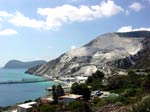 Lipari, the largest of the
Islands, has an amazing array of natural scenery to be explored, with
spectacular views across the aquamarine sea to neighbouring islands. Along the north
coast, natural resources of
volcanic
origin have
been extracted since antiquity: obsidian (volcanic natural glass),
sharper than flint, was worked into tools and weapons by Neolithic craftsmen brin
Lipari, the largest of the
Islands, has an amazing array of natural scenery to be explored, with
spectacular views across the aquamarine sea to neighbouring islands. Along the north
coast, natural resources of
volcanic
origin have
been extracted since antiquity: obsidian (volcanic natural glass),
sharper than flint, was worked into tools and weapons by Neolithic craftsmen brin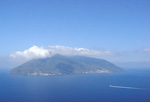 ging
prosperity to these early settlers; today the coastline is scarred by
the dazzling white waste from pumice quarries, a natural volcanic
material used in modern chemical and pharmaceutical industries. Among
the pumice waste, we were able still to find sherds of shiny black
obsidian. And along the flora-covered cliff tops of the southern
coastline, a magnificent panorama opened up towards the nearby island of Vulcano (Photo 2).
ging
prosperity to these early settlers; today the coastline is scarred by
the dazzling white waste from pumice quarries, a natural volcanic
material used in modern chemical and pharmaceutical industries. Among
the pumice waste, we were able still to find sherds of shiny black
obsidian. And along the flora-covered cliff tops of the southern
coastline, a magnificent panorama opened up towards the nearby island of Vulcano (Photo 2).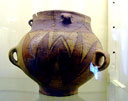 he
Museo Eoliano at the citadel in Lipari town displays archaeological
finds preserved in layers of fine volcanic ash and illustrating the
succession of cultures which flourished on the Aeolians from the 1st
human settlements in the Neolithic period through the Bronze Age to the
arrival of Greek colonists in the 6~5th centuries BC. Such was the
economic importance of obsidian working before the discovery of metal
smelting technology that remains show trading contacts between the
Aeolian Islands and Mycenaean Greece. Lipari continued as a flourishing
strategic centre during the Greek and Roman periods. Whether ancient
history is your thing or not, the museum is well worth a visit, showing
a comprehensive coverage of several millennia of local Aeolian history.
he
Museo Eoliano at the citadel in Lipari town displays archaeological
finds preserved in layers of fine volcanic ash and illustrating the
succession of cultures which flourished on the Aeolians from the 1st
human settlements in the Neolithic period through the Bronze Age to the
arrival of Greek colonists in the 6~5th centuries BC. Such was the
economic importance of obsidian working before the discovery of metal
smelting technology that remains show trading contacts between the
Aeolian Islands and Mycenaean Greece. Lipari continued as a flourishing
strategic centre during the Greek and Roman periods. Whether ancient
history is your thing or not, the museum is well worth a visit, showing
a comprehensive coverage of several millennia of local Aeolian history.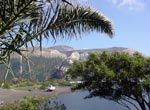 relaxed
and peaceful stay, alarm bells should ring. Officiously unwelcoming staff displayed an
inhospitable attitude and arrogant disregard for the well-being of
regular camping clientele. Baia Unci has discovered the
lucrative school party trade: the site was invaded by hoards of
screaming teenagers who were allowed to rampage around making
insufferable noise until midnight. Such were the indefensible dual
standards that regular campers were subjected to pettifogging
regulation, while in laissez-faire contrast, school parties were allowed
to run amok unchecked. After 2 days, enough was enough and we left glad
to shake the volcanic dust of Baia Unci from our feet. In 40 years of
camping, Baia Unci on Lipari was the worst campsite we have ever
experienced. Fortunately there is an alternative campsite on
the neighbouring island of Vulcano which showed a marked contrast in
attitude towards its guests. We found Togo Togo
Camping on Vulcano a pleasantly straightforward site, shaded by scented eucalyptus
trees and looking across a beach of black volcanic sand to the smoking
cone of Vulcano's Grand Crater. It was a glorious setting, but more
importantly, we were welcomed with warm hospitality by the
family; Togo Togo Camping on Vulcano is thoroughly recommended for its
setting and its relaxed and welcoming atmosphere.
relaxed
and peaceful stay, alarm bells should ring. Officiously unwelcoming staff displayed an
inhospitable attitude and arrogant disregard for the well-being of
regular camping clientele. Baia Unci has discovered the
lucrative school party trade: the site was invaded by hoards of
screaming teenagers who were allowed to rampage around making
insufferable noise until midnight. Such were the indefensible dual
standards that regular campers were subjected to pettifogging
regulation, while in laissez-faire contrast, school parties were allowed
to run amok unchecked. After 2 days, enough was enough and we left glad
to shake the volcanic dust of Baia Unci from our feet. In 40 years of
camping, Baia Unci on Lipari was the worst campsite we have ever
experienced. Fortunately there is an alternative campsite on
the neighbouring island of Vulcano which showed a marked contrast in
attitude towards its guests. We found Togo Togo
Camping on Vulcano a pleasantly straightforward site, shaded by scented eucalyptus
trees and looking across a beach of black volcanic sand to the smoking
cone of Vulcano's Grand Crater. It was a glorious setting, but more
importantly, we were welcomed with warm hospitality by the
family; Togo Togo Camping on Vulcano is thoroughly recommended for its
setting and its relaxed and welcoming atmosphere.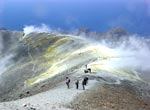 From this delightful base,
we continued our exploration of the Aeolian Islands. Vulcano itself is
dominated by the brooding cone of its Grand Crater. Although inactive
since its last eruption in 1890, this
dormant volcano still exhibits spectacular but menacing secondary
volcanic activity in the form of sulphur-encrusted steaming fumaroles
around the crater rim. The beast is now constantly monitored for any
signs of resurgent activity. It's a gruelling
From this delightful base,
we continued our exploration of the Aeolian Islands. Vulcano itself is
dominated by the brooding cone of its Grand Crater. Although inactive
since its last eruption in 1890, this
dormant volcano still exhibits spectacular but menacing secondary
volcanic activity in the form of sulphur-encrusted steaming fumaroles
around the crater rim. The beast is now constantly monitored for any
signs of resurgent activity. It's a gruelling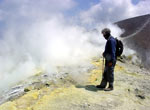 1,350 feet slog up the ash
cone of Vulcano's Grand Crater, and we paused for lunch at one of the
more bizarre spots of our travels (Photo 3). The sight however to
greet you at the rim
defies description: the crater is 650 feet deep and 6,500 feet across,
and the northern
flank is lined with a series of fumaroles (Photo 4),
bright yellow with sulphur deposits and gushing pungent smoke and steam.
And the immediate sight from this uncertain vantage point was offset by
the distant views of Lipari and Salina across the azure-blue straits. We
walked the crater's circuit to tread gingerly over the hot steaming
ground; the fumaroles are encrusted with beautiful sulphur crystals, the
air reeking of choking sulphurous gases (Photos 5 and 6). It was
like gazing on a sci-fi film set and truly one of the most memorable
experiences of our travels, and that evening from the campsite, we sat
eating supper looking directly up at the steaming volcanic cone.
1,350 feet slog up the ash
cone of Vulcano's Grand Crater, and we paused for lunch at one of the
more bizarre spots of our travels (Photo 3). The sight however to
greet you at the rim
defies description: the crater is 650 feet deep and 6,500 feet across,
and the northern
flank is lined with a series of fumaroles (Photo 4),
bright yellow with sulphur deposits and gushing pungent smoke and steam.
And the immediate sight from this uncertain vantage point was offset by
the distant views of Lipari and Salina across the azure-blue straits. We
walked the crater's circuit to tread gingerly over the hot steaming
ground; the fumaroles are encrusted with beautiful sulphur crystals, the
air reeking of choking sulphurous gases (Photos 5 and 6). It was
like gazing on a sci-fi film set and truly one of the most memorable
experiences of our travels, and that evening from the campsite, we sat
eating supper looking directly up at the steaming volcanic cone.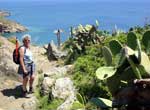 The climax to our time in
the Aeolians was to be a visit to Stromboli, the most distant of the
islands its volcanic peak being in a constant state of eruption. Our
enquiries showed the most practicable transport was to take
one of the
many long-day privately operated excursions which return late evening
allowing sight of the glowing volcanic material ejected from the island's
crater and rolling down to the sea. Although expensive, the private boats work out the same cost as
the limited hydrofoil service which would need a costly overnight stay
on Stromboli. When we
The climax to our time in
the Aeolians was to be a visit to Stromboli, the most distant of the
islands its volcanic peak being in a constant state of eruption. Our
enquiries showed the most practicable transport was to take
one of the
many long-day privately operated excursions which return late evening
allowing sight of the glowing volcanic material ejected from the island's
crater and rolling down to the sea. Although expensive, the private boats work out the same cost as
the limited hydrofoil service which would need a costly overnight stay
on Stromboli. When we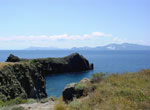 came to book however, we learned to our bitter
disappointment that,
since vigorous eruptions in February this year, Stromboli had been
uncharacteristically quiescent, emitting not the usual spectacular lava
fireworks, but merely dangerous volcanic gases. As a result, not only
would there be no explosive volcanic activity to witness at close
quarters but the whole summit area was now 'out of bounds'. Even the
more restricted guided climbs were already fully booked. We had therefore to
settle for a more limited experience and hoped that we could at least
sample Stromboli. The boat sped out across the open channel, approaching
firstly Panarea whose sheer volcanic cliffs loomed ever closer.
Frustratingly, undue time was allocated here, and although Panarea is a
beautiful island, we were anxious to reach Stromboli. The views however
from the southern cape, with the panorama of Lipari, Vulcano and Salina
spread along the horizon, were spectacular (Photo 7).
came to book however, we learned to our bitter
disappointment that,
since vigorous eruptions in February this year, Stromboli had been
uncharacteristically quiescent, emitting not the usual spectacular lava
fireworks, but merely dangerous volcanic gases. As a result, not only
would there be no explosive volcanic activity to witness at close
quarters but the whole summit area was now 'out of bounds'. Even the
more restricted guided climbs were already fully booked. We had therefore to
settle for a more limited experience and hoped that we could at least
sample Stromboli. The boat sped out across the open channel, approaching
firstly Panarea whose sheer volcanic cliffs loomed ever closer.
Frustratingly, undue time was allocated here, and although Panarea is a
beautiful island, we were anxious to reach Stromboli. The views however
from the southern cape, with the panorama of Lipari, Vulcano and Salina
spread along the horizon, were spectacular (Photo 7).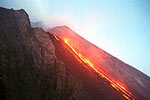 At 3-30 we
were at last on our way to Stromboli, and as we approached, the island
looked fearsome with its cone capped by volcanic cloud. Rounding the
craggy western side, there ahead was the mighty Sciara del Fuoco (Slope
of Fire) down which incandescent lava from the volcano normally spills.
But
At 3-30 we
were at last on our way to Stromboli, and as we approached, the island
looked fearsome with its cone capped by volcanic cloud. Rounding the
craggy western side, there ahead was the mighty Sciara del Fuoco (Slope
of Fire) down which incandescent lava from the volcano normally spills.
But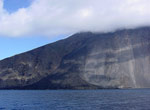 today, with the volcano not erupting, there was no trace of glowing
lava, just the barren grey slopes of volcanic debris (see left for the
Sciara's normal fiery appearance, and right for our experience). From
the seaward northern side, the panorama of Stromboli was a formidable
sight with the afternoon sun illuminating clouds of volcanic gases
billowing down steep gullies from the crater (Photo 8). Our time
ashore was limited, allowing opportunity only to walk out towards the
observatory above the Sciara del Fuoco across the barren black landscape
which contrasted starkly with the island's white cottages. It was a
brief and frustrating visit with little to see of the volcano in its
uncharacteristically quiescent state. But at least we had witnessed
unsurpassed views from the sea. Despite our disappointment, emergency
evacuation signs pointing to muster points in the event of eruptions
showed that Stromboli does pose a serious threat to the islanders. We were unlucky with timing of our visit to Stromboli, but to give an impression of what we had hoped to experience, included
try this link for
today, with the volcano not erupting, there was no trace of glowing
lava, just the barren grey slopes of volcanic debris (see left for the
Sciara's normal fiery appearance, and right for our experience). From
the seaward northern side, the panorama of Stromboli was a formidable
sight with the afternoon sun illuminating clouds of volcanic gases
billowing down steep gullies from the crater (Photo 8). Our time
ashore was limited, allowing opportunity only to walk out towards the
observatory above the Sciara del Fuoco across the barren black landscape
which contrasted starkly with the island's white cottages. It was a
brief and frustrating visit with little to see of the volcano in its
uncharacteristically quiescent state. But at least we had witnessed
unsurpassed views from the sea. Despite our disappointment, emergency
evacuation signs pointing to muster points in the event of eruptions
showed that Stromboli does pose a serious threat to the islanders. We were unlucky with timing of our visit to Stromboli, but to give an impression of what we had hoped to experience, included
try this link for
 Despite adverse winds and
unpredictable ferries, we eventually arrived back at Milazzo on the
Sicilian 'mainland', and as we approached the port at dusk, 2 porpoises
passed by arching out of the sea. Our final week would be spent along
the north coast. Compared however with our time elsewhere in Sicily,
this was something of an anticlimax. The mountainous hinterland dropped
steeply down to a narrow coastal strip along which motorway, railway and
Despite adverse winds and
unpredictable ferries, we eventually arrived back at Milazzo on the
Sicilian 'mainland', and as we approached the port at dusk, 2 porpoises
passed by arching out of the sea. Our final week would be spent along
the north coast. Compared however with our time elsewhere in Sicily,
this was something of an anticlimax. The mountainous hinterland dropped
steeply down to a narrow coastal strip along which motorway, railway and main road competed for space and which was populated with a series of
unattractive and eminently forgettable resorts. This
was the least appealing part of Sicily we had seen. Even worse however
were some of the surly attitudes we encountered both on the Aeolians and
along the north coast. Their economy is totally dependent on tourism,
but they resent visitors, and show it - we want your money but not you.
This was such a stark contrast with the helpful and hospitable welcome
we had universally received in other parts of the country. Our
conclusion therefore was that if you go to Sicily, confine your visit to
the west, south and east of Sicily; there is far more of natural and
historical interest there and the people are so much more pleasant. But
all was not lost: a couple of days walking and wild-camping in the
Madonie Hills gave a magnificent conclusion to the trip. And to cap it
all, we were rewarded with a final glimpse of the distant snow-covered
peak of Etna with its characteristic plume of cloud.
main road competed for space and which was populated with a series of
unattractive and eminently forgettable resorts. This
was the least appealing part of Sicily we had seen. Even worse however
were some of the surly attitudes we encountered both on the Aeolians and
along the north coast. Their economy is totally dependent on tourism,
but they resent visitors, and show it - we want your money but not you.
This was such a stark contrast with the helpful and hospitable welcome
we had universally received in other parts of the country. Our
conclusion therefore was that if you go to Sicily, confine your visit to
the west, south and east of Sicily; there is far more of natural and
historical interest there and the people are so much more pleasant. But
all was not lost: a couple of days walking and wild-camping in the
Madonie Hills gave a magnificent conclusion to the trip. And to cap it
all, we were rewarded with a final glimpse of the distant snow-covered
peak of Etna with its characteristic plume of cloud.